
As with all training, the more frequently you practice handling and the more fun and rewarding the exercises are, the more likely the exercises are to be successful. Therefore, practicing training exercises during your dog’s mealtimes is a great idea. You can practice body handling as well as basic manners. He’ll learn to associate being handled with something he already loves — his food. Also, since feeding your dog is part of your daily routine, practicing at mealtimes is a good reminder for you to maintain his skills by consistent repetition. Remember, the more you practice mealtime handling exercises, the more confident you can be that you will prevent problems later.
Whenever possible and appropriate, include family members and friends in mealtime training exercises to teach your dog to appreciate people being near him when he eats his meals.
Play Doctor
This training exercise, where you “play doctor” with your dog, will effectively teach him to become comfortable with being handled. In a quiet area of your home, have your dog on leash. Start by gently touching an area of his body that you think he isn’t likely to mind (usually around his back) for just one second, and then give him a piece of food. Repeat this process a few times and then move on to another part of his body. Many dogs are most sensitive around the head and feet, so handle these areas last so that your dog is clearly focused on the task at hand — allowing a brief touch for a bit of food. When he seems completely comfortable with a one-second touch on a particular body part, increase to two seconds before giving a piece of food. Your goal is to gradually increase the duration of each touch. ‘
It’s very important to go slowly. If you go too fast, you may miss subtle cues that your dog isn’t enjoying being touched in a certain area.
Signs You’re Moving Too Fast
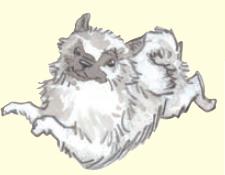
If your dog does any of the following things excessively, you might be moving too quickly:
- Avoids eye contact with you
- Changes his ear placement
- Flinches
- Licks his lips more than normal
- Tries to pull away
- Yawns
In that case, take a step or two backward. If you are touching for five seconds, for example, go back to one or two seconds and consider upping the payoff for your dog. Maybe at this stage in the training game, your dog requires a tasty treat instead of a piece of dry food in exchange for you holding his paw.
Don’t forget to gently examine your dog’s mouth, take a look inside his ears, and check between his toes. For each new area you touch, offer a tasty bit of food. Be especially generous when you touch areas that your dog is more sensitive about: often the feet and around the head. If your dog is squirmy, you can tie him to something stable or have someone hold him at the beginning so that you have both hands free to pet and reward promptly.
Repeat this process with your dog’s grooming tools. Start with one stroke of the brush, and then offer a piece of food. Now try two strokes and then a piece of food. Pick up one foot, lay nail clippers against it, and offer a bit of food. Then look into one of his ears and offer a piece of food. Don’t rush things. Take time to make sure that your dog enjoys minimal examining before you actually clip a nail or clean his ear.
For the sake of both of your enjoyment, invite your dog over for a belly rub at least once a day. This is a great way to show him how enjoyable being handled can be. While rubbing him in a spot he likes very much, you can also gently handle his ears, feet, and other body parts.
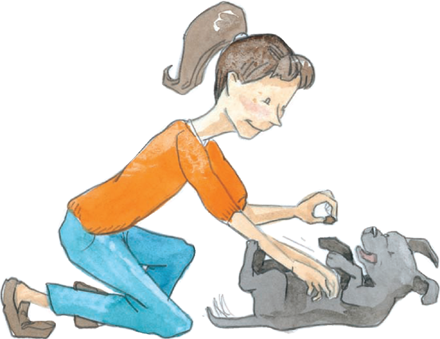
A tummy rub and a treat will teach any puppy to love handling.
Handling Checklist: Getting Used to Handling
✓ Apply medications to your dog’s skin or in his eyes or ears.
✓ Groom or bathe your dog.
✓ Inspect your dog’s fur.
✓ Look inside your dog’s ears and eyes.
✓ Look inside your dog’s mouth.
✓ Take things from your dog’s mouth.
✓ Touch your dog’s back.
✓ Touch your dog’s collar.
✓ Touch your dog’s head.
✓ Touch your dog’s paws.
✓ Touch your dog’s rear end.
✓ Touch your dog’s tummy.
You Look Marvelous!

No matter what type of coat your dog has, he should be comfortable letting you groom him—even if it’s just to wipe his body with a towel, clip his nails, or clean his ears. If you set aside five minutes a day for a couple of weeks, you’ll find that you have a dog who loves to be groomed. Be gentle so that grooming becomes an enjoyable bonding experience rather than a stressful chore.