Supervision, food-stuffed chew toys, short-term and long-term confinement, and a food and water schedule are the five best tools to aid you in house training. Depending on your dog’s age and level of training, as well as the particulars of your lifestyle, you may choose to use only some of these tools. However, the wise use of all five will help your dog avoid mistakes whether you are home or not. As a side benefit, using these tools is also a great way to prevent separation anxiety and avoid puppy nipping, inappropriate chewing, and greeting problems. These tools should all be used diligently until your dog understands the house rules, at which point he may enjoy as much freedom in your home as you feel is appropriate.
Supervision
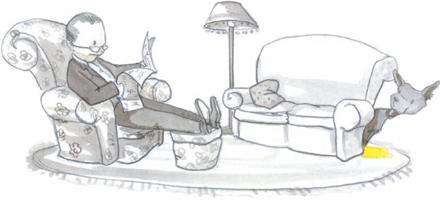
Just as you would diligently supervise a young child in your home, so should you diligently supervise a puppy or “adult dog in house training.” Until he is house- trained, your dog should be supervised whenever he spends time in the home (unless he is in one of the two confinement areas listed below). You must be able to give him 100 percent of your attention. Taking your eyes off your dog for even a few moments is plenty of time for him to urinate, defecate, chew on the furniture (or worse), or chew on an electrical cord or other hazardous object.
Give your dog a chew toy, step on his leash, and settle down with a good book. In no time, your dog will have a habit of settling quietly at your side, even without a leash on. When necessary, take him to his doggy toilet and let him relieve himself.
Keeping your puppy or new adult dog on leash during these supervised times out of his confinement areas is a great idea until he is house trained and chew-toy trained. The leash will remind you to watch him like a hawk. It is also a good idea to bring him into areas of the home outside of his confinement area only when you know that he has an empty bladder and bowel (that is, after you have just seen him eliminate in his doggy toilet), or until he is house trained.
For the first week, keep the leash connected to you. Either step on it to keep your dog by your side, hold it in your hand, or tie it to a stable object right next to you. Your pup can spend his time playing a game with you, chewing on a chew toy, or just resting. As your puppy or dog starts to understand the rules, you can give him a little more access to the room you are in by tethering him to a stable object nearby or by letting him drag the leash behind him (but only at a very short distance away!). Eventually, he will be house trained and chew-toy trained and will be able to enjoy time off leash in his home.
Short-Term Confinement
The primary function of short-term confinement is to predict the exact time of elimination. There are many side benefits, including preventing your dog from making mistakes in your home and teaching your dog to tolerate quiet time alone. In regard to its use for house training, your dog has a natural inhibition against soiling his sleeping area. If your puppy has been confined in his bed or crate or on leash by your side for thirty minutes or more, you can bet that he will promptly relieve himself when taken to his doggy toilet.
By taking your puppy or dog out often, you will have many opportunities to show him where the right place is to go, and you will teach him to build bladder and bowel muscle control gradually and therefore successfully. Short periods spent in his confinement area have the added benefits of getting your dog accustomed to being left alone (essential for preventing separation anxiety issues) and teaching what is appropriate to chew (the chew toys you leave with him). When you are away from home for short periods, confine your dog to his short- term area—either a crate or a tie-down. When you are home, keep your dog in his short-term confinement area if you cannot devote 100 percent of your attention to him.
What’s a Tie-Down?
A tie-down is sort of like a crate without walls. Using a leash, tie your dog to a stable object (such as a heavy piece of furniture or an eye hook in the wall), or simply step on the leash to keep your dog at your side. Just as with a crate, a tie-down is meant to inhibit your dog’s elimination and keep him in a safe area so he can’t chew inappropriate objects and otherwise get into trouble.
Some owners prefer a simple tie-down, “a crate without walls.”
Get Your Dog Comfortable with His Crate
While it is true that dogs in the wild are considered den animals, that does not mean that your dog will necessarily take to his crate — if only for the fact that, unlike a den, a crate has a door that you close securely. You need to teach your dog to tolerate, and eventually enjoy, his personal space. There are two steps to this process:
1.Associating the crate with things your dog already likes (food and toys)
2.Gradually increasing the length of time that your dog spends in his crate
Be sure to put your dog in his crate only after you have seen him eliminate, so you are sure that his bladder and bowels are empty and there is very little chance of him soiling in this area.
Start by leaving the crate door open and tossing in a few treats. Your dog will eventually go in to investigate, especially if you plan the first few sessions during his mealtimes. When he moves confidently into the crate, offer him some extra- tasty, tiny treats for staying in there for an extra moment or two. You can gradually increase the time you have him wait in the crate for his treat from one second to two, three, four, five seconds, and so on. By repeating this process, your dog will start to want to go into the crate. Why? Because that’s where all the good stuff is! Now, when you put your dog in the crate, wait a few moments before giving him a treat. At this point, you might try giving him a food-stuffed chew toy. If you have already created a chew-toy habit in your dog, this process will be even easier because he will be occupied with his chew toy and hardly notice that he is confined.
It is advisable to feed your dog some of his meals in the crate. At first, feed from a bowl, but gradually work toward feeding from food-stuffed chew toys so that when he heads into the crate (which has become his dining room!), he is prepared to hang out and work at his toys to get his meal.
A good general rule is that you should confine your dog in his crate for only as long as you are willing to bet $500 (or whatever sum is important to you!) that he can hold it. And of course, never exceed a length of time that is reasonable and humane. Like any tool, the crate must be used thoughtfully and purposefully in order to be useful to you and pleasant for your dog. If introduced correctly, the crate can become a source of great comfort to your dog, as it is a place where he goes to rest, eat, and play with his food-stuffed toys.
Can My Puppy Sleep through the Night?
To help your puppy sleep as long as possible, take away his water three to four hours before you plan to put him to bed, unless your pup is not feeling well and your veterinarian advises otherwise. If you aren’t willing to bet that your pup can hold it through the night, then you can leave him in a well- designed long-term confinement area, giving him access to a toilet so there will be no need for you to wake up to take him outside. Alternatively, you can leave him in his crate in your bedroom and set your alarm so that you can wake your pup and carry him to his toilet. This is wiser than allowing him to wake you by crying or barking. After he goes, bring him right back to his crate to go back to sleep; do not play with him, or you will teach him to wake you to play.
Daytime Crate Duration Guidelines
Here is a general guideline for the length of time a puppy can spend in a crate before getting a break to go to the bathroom. As a general rule, a puppy can hold it longer at night than during the day.
| Puppy’s age |
Provide a break for your puppy |
| 8–10 weeks |
Approximately every 30–60 minutes |
| 11–14 weeks |
Approximately every 1–3 hours |
| 15–17 weeks |
Approximately every 3–4 hours |
| 18+ weeks |
Approximately every 4+ hours (6 hours maximum) |
Long-Term Confinement
If your schedule does not permit you to be present to let your puppy or “adult dog in house training” out for frequent opportunities to eliminate, then you should leave him in a long-term confinement area. This area should provide your dog with everything he will need — chew toys, water or ice cubes, and a suitable indoor toilet. The indoor toilet is only necessary until your puppy has built sufficient bladder and bowel control and can be expected to hold it for several hours at a time. However, if you have a very small dog, you may want to have your dog use an indoor toilet permanently in addition to eliminating outdoors.
Long-term confinement options include:
- A bathroom gated off with a baby gate.
- An exercise pen that includes a crate. In this case, the crate is the dog’s bed- room and the dog’s toilet is in the area sectioned off by the ex-pen.
- A crate connected to a doggy door that leads to a safely enclosed dog run. Your dog will essentially have a toilet and a bedroom. With this setup, your dog will all but house train himself!
If you leave an un house trained dog confined to a crate for a long period, he will be forced to soil his sleeping area. This is not only unkind, but it will also make it extremely difficult to house train him. So, for lengthy periods of confinement, either plan to have someone come in to give your dog a relief walk or leave your dog in an area that has a toilet if you can’t offer him adequate relief walks from his crate and he is not yet capable of holding it for prolonged periods.
When spending time in his long-term confinement area, your dog can’t make house-soiling (and chewing) mistakes in the rest of the house. So, rather than leave your puppy or dog to roam around your home and make mistakes (for which he will inevitably be punished later), it is much wiser simply to keep your dog in one safe area until he can be trusted to handle freedom in your home.
An ideal and easy-to-construct long-term confinement area.
Yippee! You’re Here!
When you get your pup from his sleeping area in the morning, don’t encourage his excitement at your arrival. Doing so will only make him more likely to have an accident before you get him to his toilet. Instead, calmly walk in and immediately pick him up to take him to the area where you expect him to relieve himself. Then, of course, let him know how fantastic it is that he went in the right place.