A great dog waits patiently and asks appropriately for what she wants. A demanding and impatient dog is likely to whine, bark, and jump to get what she wants. A dog in this state is similar to a child who is distraught over the injustice of not getting what she wants when she wants it —which is usually right now!
As a dog-friendly trainer, you recognize that while it is normal for a dog to want to access reinforces (anything she wants) as directly and promptly as possible, a dog who behaves in this way is not likely to enjoy as many freedoms or be adored by all as she might be if she just learned a little self-control. Your dog needs to learn that the only way to get what she wants is to wait for you to give her permission. You are the source of all the things she wants, and the only way to get you (or anyone else) to give her those things is to remain calm and do as requested.
Developing your dog’s self-control will facilitate a better relationship between you and potentially a longer and safer life for your dog, too. A dog with great self- control is much less likely to run through a doorway or out of a car door and onto the street where she may get hurt. She is also less likely to grab food from some- one’s hand and potentially cause injury by not being careful and thoughtful enough to take the food gently when given permission.
People who feel bad when they don’t give a dog what she wants inadvertently encourage the dog’s lack of self-control. This is a perfect example of killing with kindness — that is, trying to do right by a dog but ultimately teaching her very bad manners that will affect all aspects of her life.
The main focus of teaching impulse control is to stop everything when your dog gets into a demanding frenzy. Ignore your dog completely, and be sure she gets no access to the thing she wants. If she gets herself into a tizzy at the front door demanding that you open it for her, for example, simply stop and wait. Remain perfectly still. It shouldn’t take her long to figure out what she has to do to get you to open the door. When she remains still and quiet for a moment, mark with a click or by saying “yes” and reward her by opening the door. Likewise, as you prepare her meals, stop all preparations if she does anything other than wait calmly for you to finish. You can put the food out of your dog’s reach and walk away. Walk back to the feeding area when your dog is calm with four feet on the floor. This may take many repetitions, but eventually your dog will learn to stay calm while food is being prepared.
Silence Is Golden
If your dog is being impulsive, it is best to ignore her completely and make sure that she has no access to what she desires. This way, she learns that those behaviors don’t work. It may be difficult at first to teach this principle without saying words such as “off,” “down,” or “no,” but the benefit of this silent way of teaching is that your dog will learn to stay calm without you having to say these things constantly.
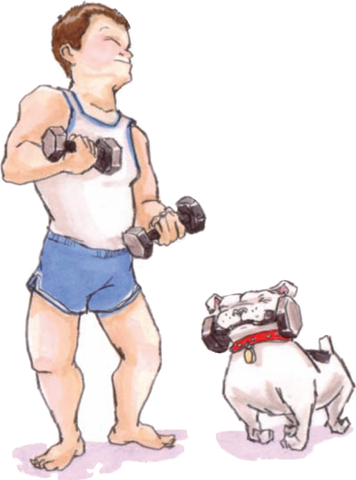
Repetitions are the key to building physical muscles and learning muscles.
To follow are some excellent impulse control exercises that you can begin to teach in a calm environment. As your dog masters these skills, practice them in more distracting areas and eventually implement them into your dog’s daily routine. For example, teaching your dog not to touch a treat on the ground until given permission to do so can be an exercise that you repeat at mealtimes when you place your dog’s food bowl or food-dispensing toy on the floor. Practicing these exercises in as many environments and as frequently as possible is the best way to develop a dog who understands that good things come to those who wait!
Since your dog is genetically predisposed to “take things now!” keep in mind that helping her learn to control her impulses in many different environments and scenarios will require many repetitions. For example, your dog might learn to show impulse control in the following exercises in your living room, but will need to essentially relearn how to control herself in more stimulating environments, such as on the street and around children and other dogs.
In addition to consistent repetition, be very generous with reinforcements so you convince your dog that waiting for something — which is typically not a natural instinct for dogs — is the best option.
Don’t Encourage Impulsive Behavior!
Be careful not to accidentally decrease impulse control by:
Giving your dog a meal after she jumps about as you prepare it.
Allowing anyone to talk to your dog (even to say something like “off,” which is negative, but is still attention) when she jumps up.
Allowing anyone to talk to your dog when she barks.
Allowing anyone to let your dog out of her crate, exercise pen, or any other enclosure when she is jumping, barking, or whining.
Allowing anyone to give your dog a treat when she jumps for it or takes it in a rough manner. (You should not feel teeth on your hand.)
Allowing your dog to greet or play with other dogs when she drags you to- ward them.
Allowing your dog to grab things off counters and tabletops.
Allowing your dog to grab things from your hand.
For Most Dogs, Negative Attention Is Better Than None at All
Talking to or even looking at your dog when she barks, whines, or jumps is likely to reinforce the behaviors happening at that moment. For most dogs, any attention — even negative attention, such as yelling “no”— can be very reinforcing, as it is better than no attention at all.
This exercise is an easy way to teach your dog to keep four feet on the ground when someone is holding food nearby. Hold a tiny treat about one foot above your dog’s head. If your dog jumps for it, quickly lift your hand out of your dog’s reach, and don’t say a word. If your dog stays standing or sits for even one second, mark this behavior with a click or by saying “yes” and give her the treat.
Because you can repeat this game so quickly, you should be able to practice many repetitions in each three- to five-minute session. It usually takes just one or two sessions for your dog to understand that jumping makes the food go away and standing or sitting makes it appear. But your goal is to teach her to do so for as long as necessary — that is, not to jump for the food at all. When your dog is keeping four paws on the ground for a count of one, you can gradually increase the time you ask her to hold the position by delaying the mark and reward. Gradually in- crease the count to two, three, four, and so on, but be careful not to go too quickly, even if you have a super-smart dog. As with every training exercise, your goal is to set a solid foundation, which is best done slowly.
Time-outs are one of the most effective punishments. They tell your dog that whatever he was doing right before it happened resulted in him losing access to anything he wants, such as treats, toys, or your attention.
As you increase the duration you ask your dog to control herself, consider in- creasing the value of the reward. Maybe try using a tastier treat. Most important, be sure to be a generous re warder. The pieces can be tiny, but should be offered frequently so that your dog learns how valuable it is to wait.
Actions Speak Louder Than Words
As a calm, gentle trainer, remind yourself that actions speak louder than words. Think of yourself as having an on/off switch that your dog can control with her behavior. Jumping, barking, and whining make you turn off, and sitting politely and waiting make you turn you on.
Wait, Please
There are two parts to teaching your dog to wait to touch food or other objects until given permission. If you practiced the anti–jumping bean exercise described above, you have already laid a foundation for this exercise.
Teach your dog not to touch things that you are holding.
2. Teach your dog not to touch things that you place on the ground or on an- other surface.
Start with number 1. Hold a piece of food in your closed hand. Ignore your dog when she pushes at your hand to get the food. Ignore everything she does to get at it (she may paw or bark). When she stops and backs off, click or say “yes,” open your hand, and say “take it.” To begin, even a momentary retreat should be marked and rewarded.
One of the foundations of impulse control is your dog learning not to charge for his food bowl until you have given him permission.
Gradually increase the length of time you ask your dog to avoid making contact with your hand before you mark and reward. When you feel confident that she understands what is expected, you can add a cue like “leave it.” Say “leave it,” present your closed hand, wait for your dog to back off, and then open your hand and say “take it.” She’ll learn that the only way to get the food after you say “leave it” is not to touch your hand.
To teach your dog not to touch a treat (or object) placed on the floor, sit on the floor next to your dog and ask her to sit or lie down. Place a piece of food on the ground about 12 inches away from your dog. If she gets up to take it (which she surely will), simply lift the food off the floor and either ignore your dog and wait for her to sit or lie down on her own, or ask her to. Place the food back on the ground and try again. If she refrains from going toward the food for even a moment (one second will do!), mark with a click or by saying “yes,” and let her take the food. Gradually increase the length of time she is required to refrain from taking the food.
When you feel confident that your dog has a reliable understanding of and adherence to what is expected, you can start dropping the food on the ground from an inch or so above the floor. Gradually increase this distance until you are able to drop the treat from a standing position. If your pup forgets her manners and jumps up to get the food and you think you won’t be quick enough to reach down to take it away, try stepping on it!
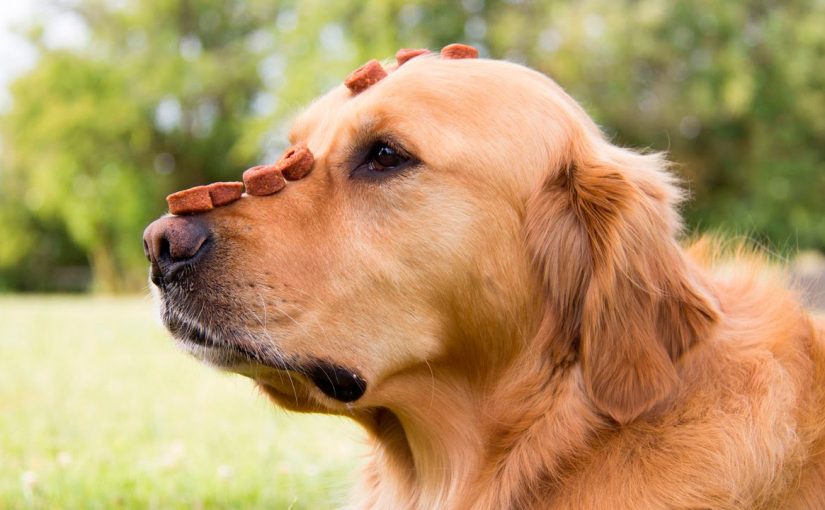
You can also work separately on decreasing the distance the food is away from your dog. But when doing so, be sure to decrease the time. For example, if your dog has a solid fifteen-second wait while the treat is 12 inches away, start back at one or two seconds when you move the treat a few inches closer. Most dogs can master this challenge so well that you can eventually place the treat on their paw and they won’t touch it until given permission to do so.
What terrific self-control!
Yippee, You’re Here!
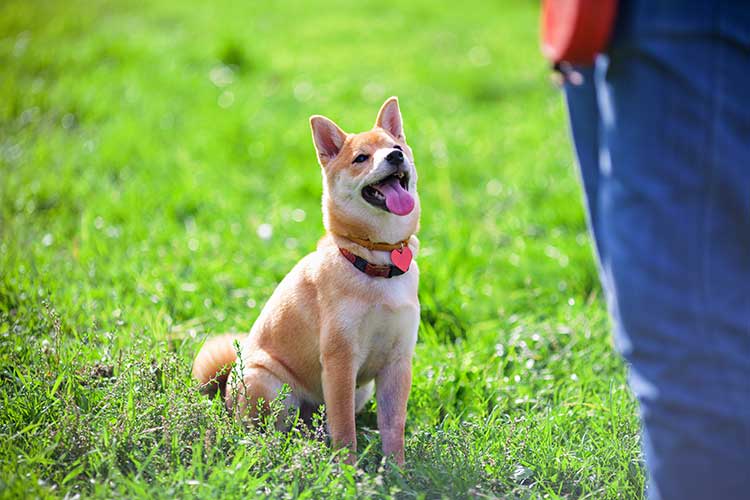
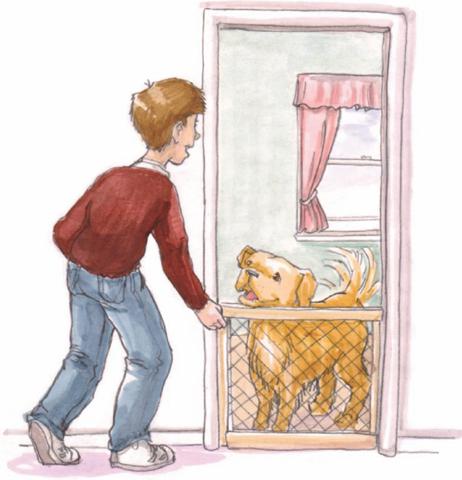
When your dog is confined away from you in any manner (in her crate, tethered on a leash, behind a baby gate, or in another room), teach her that the only way to get you to approach is to keep all four feet on the floor. If she jumps, turn or walk away. When she has all four feet on the floor, start approaching again. As with all teaching, it will take many repetitions for your dog to figure out that keeping four feet on the floor is the way to get you to approach. You may find yourself walking back and forth for a few minutes until your dog is able to contain her enthusiasm.
On/Off Switch
In this game, you help your dog learn to show self-control in stimulating situations, such as around children or crowds. This on/off exercise is also a great opportunity to use play as a reward for self-control.
Start by playing with your dog in very short bursts separated by short periods of lying down. To begin, short sessions are best because some dogs will become overstimulated. As your dog masters the concept that lying down calmly is the way to get the game to start again, you can vary the length of time you play and ask your dog to lie down. Calming to a less aroused state is easier for some dogs than others, so it’s important to have a good idea of what level your dog can handle and not to push her too far too fast. As with all dog-friendly training, your goal is to set your dog up to be successful.