
What does a bark mean? Well, what does a word mean? The bark is a dog’s word, and it can mean many things. Your dog barks when she’s alerting you to an intruder, when she’s afraid or stressed, when she’s feeling playful, and when she’s bored. Barking is caused by the presence of stimuli (strange people, dogs, sights, or sounds) or the owner’s absence, and can be an attention-seeking mechanism.
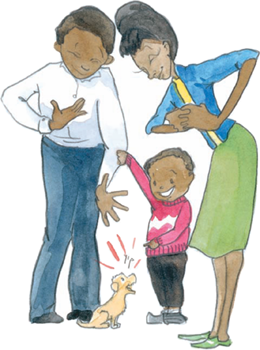
Most behavior problems are unintentionally encouraged during the first few weeks a puppy or dog is in her new home. For example, this puppy is learning that barking is a good way to be the center of attention.
The easiest way to control barking is to socialize your dog so that she’s comfortable with lots of people, places, and things and to instill in her a strong chew- toy habit so that she is mentally and physically exercised and occupied. But, just as you would not attempt to completely silence a person, you shouldn’t try to completely silence your dog. Your dog just needs to learn some basic bark control — when it is appropriate and acceptable to bark and for how long.
Regardless of the reason for your dog’s barking, your goal is to properly socialize your dog, teach your dog to focus on something other than barking, and teach your dog to speak and be quiet on command so that you can control when and for how long she barks.
Alarm Barker
Dogs who bark at the presence of intruders can be valuable assets. It’s ironic that barking dogs are such a problem in our society, inasmuch as barking as an alarm must have been one of the main reasons we domesticated dogs in the first place. Usually, it isn’t the barking that is a problem — it’s just that the dog is a little too enthusiastic. Most people want their dogs to let them know when someone has stepped onto the property. Barking becomes a problem only if the dog doesn’t settle down when you ask her to.
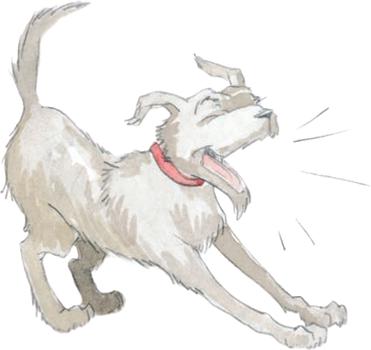
Until you have this problem under control, keep your dog on leash at all times when you are home to supervise her. This way, you have a gentle, effective means of preventing her from rushing to the door and barking uncontrollably. Teach your dog to bark and be quiet on cue and thereby have an on/off switch. To do so, invite three friends to come over for a speak-and-shush party, and within 30 minutes you’ll have the foundation of a well-trained barker and shusher.
Have your dog’s dinner kibble on hand. Ask your dog to speak (request), in- struct your visitors to knock on the door when they hear you say this (stimulus), and let your dog know that barking was the right response by saying “thank you.” At this point, your dog may look a bit shocked. After all, she’s probably used to being yelled at when she barks.
Now, to get her to be quiet, say “shush” (request) and waggle a very tasty treat in front of her nose. Once she sniffs the food, she’ll be quiet (she can’t sniff and bark at the same time), so give it to her as a reward. Repeat this process many times, and your dog will become increasingly aware of how much fun it is to speak on request and how rewarding it is to shush on request.
Yard Barker
Barking dogs are one of the most common complaints of urban and suburban neighbors. Obviously, a dog left outside will alert to all the visual and auditory stimuli.
Dogs are usually relegated to the yard because they’re not house trained or chew-toy trained. If that’s the case, house train and chew-toy train your dog. Rescue her from the backyard and bring her into your home!
Giving your dog a few well-stuffed chew toys is the easiest and most effective way to prevent barking. This way, she has something to think about other than barking. A well-stuffed chew toy will keep your dog busy for an hour or more (this means no time for barking). If you need to, put her food bowl away and feed her only from her chew toys. You’ll keep her very busy!
No Yard Dogs, Please
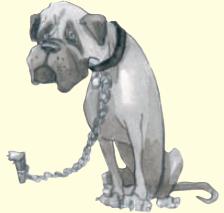
It’s not a great idea to leave your dog alone in your yard. Not only will her house training and manners deteriorate, but she’s also likely to learn and engage in activities you won’t appreciate, such as digging, barking, or escaping. Moreover, she’s vulnerable to a number of dangers, including being stolen, poisoned, harassed by passersby, or hurt by an animal that comes into the yard.
Attention-Seeking Barker
Many people inadvertently train their dogs to bark for attention by responding to barks and whines. This is especially true with young puppies and very tiny dogs whose little whimpers and whines bring their owners running. However, regardless of size, most dogs develop a formidable bark that is likely to become more demanding in nature as they learn to expect a response. What starts off as a soft little whimper can quickly turn into an ear-piercing shout — the dog’s way of saying “I want attention! And I want it now!”
You can prevent your dog from learning that barking and whining is an effective way to get your attention simply by ignoring any vocalization. Admittedly, doing so can be difficult at first, but most dogs figure out quickly that vocalizing doesn’t work. They are also quick to figure out if it does work, so be careful not to reinforce this behavior occasionally by talking to or even looking at your dog when she barks for attention.
If your dog has already been reinforced for barking for attention, you can teach her that it no longer works simply by starting fresh and ignoring her when she barks. When you’re relaxed and in a good mood, tie your dog to a secure spot in the house and get a good book to read. Sit next to your dog and ignore her. If she whines or barks, ignore her or move a short distance away. When she’s quiet, even for a moment, move closer. Your dog will soon realize that barking means you leave and quiet means you return. When she’s quiet for a few moments, you can click or say “yes” and reward her with a tiny treat. You can also praise her very calmly.
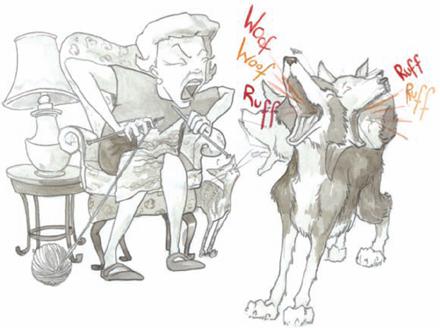
If your dog is barking for your attention . . .
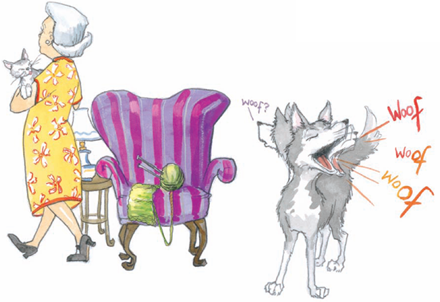
. . simply teach her that it will have the opposite effect.
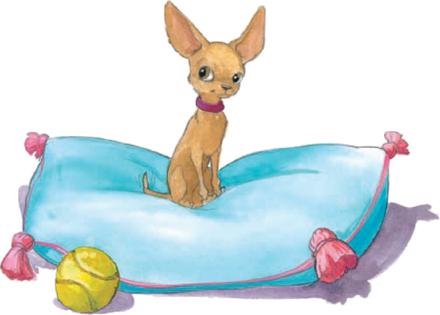
Some dogs were specifically bred to be companions, and they may especially miss you when left at home alone. So teach them right away to tolerate and even enjoy time by themselves.
Owner-Absent Barker
What if your dog barks because she’s bored or stressed when left at home alone? Unfortunately, our canine friends are often left alone for long periods. Being social animals, dogs find it tough to understand why their families leave them. However, you can teach your dog to tolerate and even enjoy your absence.
First, teach your dog to spend time alone while you’re at home. Most people make the mistake of spending all their time at home with their dogs at their sides. While this act may seem kind and loving, it only makes matters worse. Your dog will become accustomed to constant companionship and will be more likely to fall apart when you leave.
Instead, teach your dog to enjoy quiet moments by herself while you’re at home so that she’ll feel more confident when you’re not there. Frequently and for short periods, confine your dog to another room, in her crate, or on a tie-down and give her a couple of well-stuffed chew toys to occupy her time. In fact, make a habit of giving your dog as many of her favorite things as possible (including her meals in food-dispensing toys) when you ask her to be by herself.