Garbage Raiding

Dogs are naturally investigative creatures; like many of us, they are always on the lookout for a tasty morsel. Therefore, it should come as no surprise that your dog might try to figure out a way to gain access to the garbage, which is surely full of delicious leftovers. 

To discourage garbage raiding, get a garbage can that has a locking lid. Or simply put the garbage can in a place your dog can’t reach, such as under the sink. If you attempt to correct your dog when you catch her raiding the can, chances are all she will learn is to avoid going on a garbage hunt when you’re around. You’ll essentially have created an owner-absent garbage hound. 

Eating Feces

Eating feces is a distasteful habit that many dogs will engage in if given the chance. Most commonly, dogs will eat the stools of other animals. Less commonly, dogs may eat their own stools. 

The most likely cause of this habit is boredom. However, some experts suggest that it may be caused by a nutritional deficiency, so make sure that your dog’s diet is well balanced and speak with your dog’s veterinarian to rule out this possibility. 

The solution to feces eating starts with preventing your dog from having the opportunity to practice this behavior. Each time she does it, the habit becomes stronger. If you are walking in the woods with your dog, simply call her away from any stool and reward her with a treat. If you let your dog out in the yard to eliminate, go with her and clean up her stool promptly. 

Some people have had success with food additives designed to make the stools distasteful. More important, be sure to provide your dog with plenty of chew toys to keep her busy. 

Digging

Your dog has lots of reasons for wanting to dig. Digging is fun and relieves boredom. It also creates a cool place to lie in hot weather, and in some cases dogs dig to escape an enclosure. To prevent unwanted digging, don’t let your dog spend unsupervised time in the yard. Go outside and watch her play or, better yet, play with her. If you can’t supervise, bring her indoors. 

If you don’t want to ban digging altogether, you can teach your dog that it isn’t digging you dislike, but digging everywhere. Choose one spot and designate it as her digging pit. Think of it as her sandbox. Let her watch you bury a couple of tasty chew toys. Then encourage her to dig in that spot to get them out. Your dog will learn that this is the best (and only) place to dig, because it’s where the buried treasure is and because you are there to help her choose the right spot.

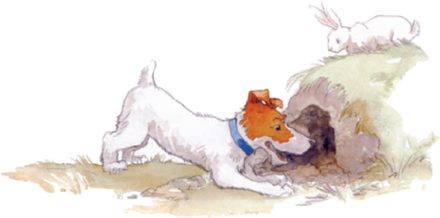
Terriers dig? Of course they do! Terrier comes from the word terra, meaning earth. Terriers were born and bred to dig. 

Hyperactivity

It’s all too common for dog trainers to hear owners describe their dogs as hyper- active. In fact, most of these dogs aren’t really hyperactive; they just have the typical energy level of a dog (high) and are in a home where the owner has the typical energy level of a person (not quite as high as a dog, especially after a long day at work). 

The simple solution to this “problem” is to make sure that your dog:  

  • Has adequate exercise. Talk to your vet about your particular dog’s needs.

  • Is fed the appropriate food. Food affects a dog’s behavior, just like it does with people.

  • Is mentally stimulated. Hide lots of fun, educational toys, such as those that can be stuffed with food, around the house.

  • Is taught to have an on/off switch. Many times throughout the day, play with your dog and get her into an energetic mood. Interrupt the play many times by asking your dog to lie down. To begin, ask her to lie down for just a few seconds before you release her, and then gradually increase the length of time you expect her to control herself and remain lying down. Continually getting your dog excited and then settling her down turns what could be a problem (an excited, high-energy dog) into a reward for calm behavior. This is a perfect example of a life reward: using something your dog likes (high- energy play) that is not concrete (not a treat or praise) to reward her for behavior that you like (lying down calmly).

Chasing

Chasing other animals and objects is a great thrill for many dogs, especially sight hounds and herding breeds. These dogs were bred specifically to chase and are likely to be highly stimulated by cars, bicycles, moving animals, and joggers. Chasing is basically an extension of the dog’s prey drive. Although this behavior is normal and natural, it can lead to trouble in many ways. A dog who chases can become a neighborhood nuisance and, worse, can cause serious injury to herself, an other animal, or a person. If your dog has a habit of chasing, keep her on leash at all times when outdoors until you are confident that you have resolved the issue.

One of the most important aspects of preventing and resolving chasing issues is to teach your dog to come reliably when called (see page 174) and to hand target for attention (see page 191). When appropriate, it is also important to set up prac- tice sessions with whatever is stimulating your dog to chase. For example, if your dog chases people riding bicycles, invite a friend over to work on conditioning your dog to remain calm and under your control when your friend passes by on the bike. 

Plan three- to five-minute sessions at times when your dog is hungry so that you have the best chance of attracting and keeping her focus, and be sure to keep her on leash. Always start at a distance far greater than what you think your dog can handle. Perhaps you need to have your friend pass by at twenty feet away in order for your dog to be able to focus on you. 

Practice hand targeting, sit, down, stand, and any other skills you have taught your dog as a way of instructing her to focus on you and respond reliably to your requests. It is important to confirm that your dog responds reliably to requests in a stationary position before you can expect her to respond to you (and come back when called) when moving away from you at a distance. 

Gradually decrease the distance between your dog and the bicycle (or whatever stimulus you are working with) when you feel that your dog can handle it. Because this closer range will be more challenging for your dog, be sure to increase the value and frequency of the rewards you give her. 

Fear of People

Reward-based techniques are the method of choice when dealing with fearful dogs. If you have a dog who’s a little afraid of or doesn’t like people, you need to find a way to get this message across to the dog: “Hey, buddy, I like you. If you’ll just come close, I’ll give you a bit of food or a toy.” Using food as a lure is an effective way to communicate when the dog is afraid of your voice or physical contact (in which case you cannot praise or pat), and it’s easy to toss a piece of food to the ground close by. Eventually, the dog will come closer, lured by the food first on the ground and then in your hand. 

Make sure that your dog is extremely interested in food by starting this exercise well before mealtimes or as a substitute for them. Sit in an armchair and scatter food around you (or a friend). Your dog can approach and retreat as she likes. As she comes closer, she gets the food, and as she runs off, she gets nothing. Once she is more interested in the food (this may take some time depending on how fearful your dog is with a particular person, so it’s best to focus on proximity first), you can take the food and talk gently to the dog in the language she has learned: come, sit, and down. This in itself is like a behavioral pacifier and will accelerate the bonding process. That is, if your dog is confident in her understanding of what is expected when asked to sit or lie down, her overall confidence may improve. This clarity means that it is easier for the dog to remain calm and focused on what to do to get a treat.  

A Tiny Touch Can Lead to So Much! 

Teaching your dog to hand target is an invaluable aid in resolving fear is- sues. The more she is rewarded for touching her nose to the hand of a variety of people, the more her confidence in and enthusiasm for people will improve. 

If you think your dog is fearful, stressed, or worried, for your dog’s sake please work on this problem before it worsens. Being anxious is no fun. If your dog has any kind of aggression problem, seek help from a professional trainer immediately (call 800-PET-DOGS or go to www.apdt.com).

Don’t Be an Overprotective Owner! 

Avoid being overly protective of your puppy or dog, especially if you have a little dog. More often than not, overprotectiveness creates or exacerbates fear and aggression problems. 

Canine Squabbles

If your dog is unfriendly with lots of other dogs, it means that she is not adequately socialized to dogs. (But don’t expect your dog to be best friends with every dog; after all, we aren’t friends with every person!) A well-socialized dog may still have occasional arguments. However, socialization ensures that your dog has the requisite social savvy to enjoyably and confidently interact with unfamiliar dogs she may meet and to resolve arguments with other dogs without doing damage. It is easiest to socialize your dog when she is young, but it is never too late to make her more dog friendly. If possible and appropriate, find dog social groups in your area where you can plan play dates with suitable dogs. 

Hand Targeting to the Rescue Yet Again! 

If you notice your dog focusing on and becoming tense at a passing dog, you can practice redirecting her attention and rewarding her for focusing on something positive by asking her to hand target. Position your hand so that your dog has to turn away from the other dog (who is a safe distance away, of course), and mark and reward for a prompt response in such a distracting environment. 

Don’t Make Matters Worse 

Owners often inadvertently train dog-to-dog aggression. When an owner sees an- other dog and tightens the leash, the owner’s tension is often relayed to the dog. The dog growls, and the owner tightens the leash more and maybe yells at the dog to “be nice!” Over time, the dog becomes conditioned to tense up as she makes the association between other dogs approaching and her owner’s anxiety. So now the dog wants the other dog to stay away, and one of the ways she tries to accomplish this is by growling and barking. Furthermore, if your dog is uncomfortable with another dog, tightening the leash excludes flight from her possible options and leaves her with fight as the primary option. Tightening the leash also distorts your dog’s body language and all but forces her to lean forward — a posture that the other dog may perceive as threatening. 

A lack of proper socialization means that your dog will never get to fully enjoy fun and games with other dogs.

Obviously, you must keep your dog on leash for safety, but you’ve got to learn to control her without tightening the leash. By keeping the leash loose and remaining calm, you may convince your dog to do the same! Also consider using a head halter (see Chapter 2) this is a time when a head halter can be very handy.

When your dog is under-socialized, everyday encounters can be extremely stressful. 

Don’t punish your dog for barking or growling at other dogs. The punishment may teach your dog to think, “I don’t like being around other dogs because I am punished whenever they show up, so I’ll bark to keep them away.” Instead, try to focus on making your dog enjoy the presence of other dogs by associating them with things she likes. 

Use Reward Training 

For dog-to-dog issues, the method of choice is capturing, and the best feedback is high-value treats and praise. Start by exposing your dog to one friendly dog at a time, at a safe distance that seems comfortable for your dog. If she lunges or barks, then you are too close. Whenever your dog does anything you deem appropriate around this other dog, mark and reward the behavior immediately. This includes looking at you, standing, sitting, or lying down calmly. It is important to keep a careful eye on your dog and be ready to give immediate feedback for even a moment of appropriate behavior. As always, repetitive reinforcement will increase the likelihood, frequency, and duration of these behaviors.

Nothing makes a dog more reactive than a tight leash, and screaming at her will only make things worse. 

Use the “Jolly” Training Routine 

To begin this routine, go outside and sit on a park bench. Whenever you see an- other dog, say, “Oh, look, here comes a cookie dog.” As soon as your dog sees the other dog, give her a treat. Even if your dog is tense and growling, and one might say that you are rewarding the dog for growling and acting badly around other dogs, things will improve quickly. The dog can’t help but make a positive association between the other dog and the high-value treat, and soon she will look for- ward to other dogs approaching. Be sure to give your dog enough space from the other dog to feel safe and comfortable. And watch for early signs of discomfort, such as yawning and excessive panting. You don’t want to push your dog too far too fast.

By rewarding your dog in the presence of other dogs, your dog will soon begin to associate the presence of other dogs with rewards.  

A variation of this game is to get very happy whenever another dog passes by. Your dog can’t fail to make the association between the appearance of another dog and your positive change in mood. This is important because your (negative) change in mood may have partially caused the problem in the first place or made the problem worse. If the dogs were left to their own devices, they would probably resolve the problem amicably. 

In some cases, it helps to hand-feed your dog and get her fixated on an object (like a chew toy or a white sterilized bone). It will give her something to focus on and associate the presence of dogs with things she likes.

Every Big Journey Starts with a Tiny Step 

If your dog is afraid of people or other dogs, it may take a bit of time for her to regain confidence. These situations require as much compassion and patience as dealing with human fears and phobias.