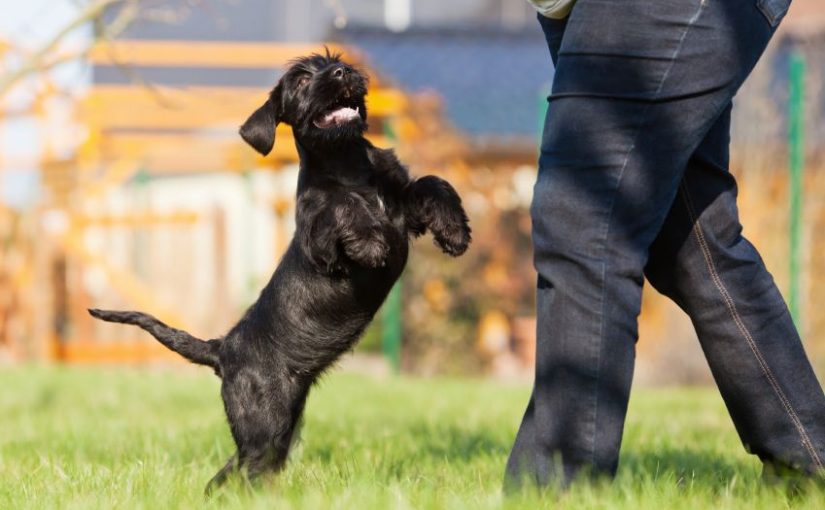
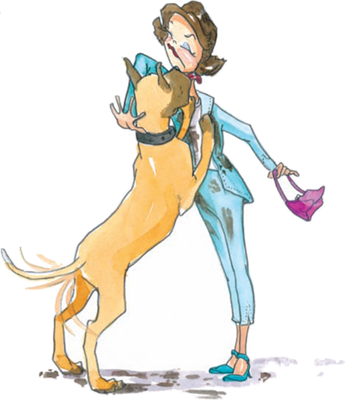
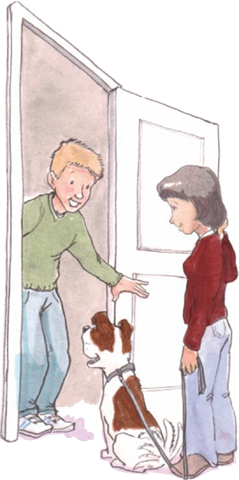
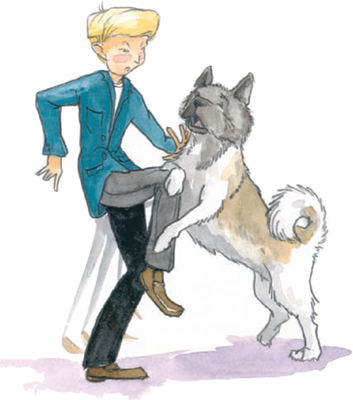
Instilling in your dog the desire to be close to you is at the heart of teaching him to come when you call and walk nicely by your side on leash. Because proximity is a sign of affection and confidence, you will have a much easier time teaching your dog to come close (recall) and stay close (walk nicely on leash) if he trusts, likes, and wants to be near you. If your dog ignores you or runs away when you call him, it tells you where you are in the relationship. In this case, you simply need to give yourself and your dog a fresh start. If you have lived together for a while, pretend as though you just brought him home and follow the instructions beginning on the next page. Using dog-friendly training techniques all but assures that you and your dog will develop a loving and trusting bond and that your dog will want to be close. A dog who likes to be close to you and has been adequately rewarded for doing so will respond enthusiastically when you call him to come or to walk by your side.
It’s very easy to instill in young puppies a desire to be close that will carry through to adulthood. Young puppies (especially those under 4 months old) have a strong tendency to follow anything that moves away. It is wise to imprint off- leash control before this time. If your pup doesn’t choose to be close to you by 41⁄2 months, then you’d better get on the ball.
On/Off Switch

Stop play sessions often to ask your dog to sit or lie down before starting play again. You’ll ensure that you can get your dog’s attention even at the height of excitement. Moreover, excited play becomes a reward for responding to your request rather than a distraction.
Come When Called
Teaching your dog to come when called is one of the most important obedience exercises you’ll ever teach. It’s the best way to allow your dog to safely enjoy off- leash fun, but more important, a good recall is the best way to prevent potential disasters. The consequences of a dog who ignores you when off leash can be devastating. Your goal with this exercise is to teach your dog to come to you even in the face of very enticing distractions. You are teaching him that it is always better to go to you than to anything or anyone else.
Choose and Use Your Recall Word Wisely
The word you use to ask your dog to come to you should be special and should be given top priority. So choose and use it carefully. If you have a dog with whom you have already used the word “come” and he ignores it, then you may want to choose a new word and start fresh.
Sit at the End

At the end of a recall, it is a good idea to add a sit. Why? Because a motivated, fast-paced recall from a medium or large dog may mean that he runs right into you or past you. So make sure that your dog knows to end up in a sit. Show your dog that you have a great treat or toy as he is about three dog lengths away from you so that he can slow down in anticipation of sitting to get it.
Someday, your dog’s life may depend on his knowing to come to you when called, so don’t ruin his recall word by using it before you have taught your dog to want to run to you. Start by saying this word only when you’re as sure as possible that your dog will respond. Do not begin by using it when your dog is off leash in an area where you are less interesting than the environment, or another dog’s rear end! If he chooses not to respond, then you have allowed your dog at least one opportunity to learn that he doesn’t have to respond. Instead, keep your dog on leash or in a safely enclosed area until you have taught him to come when called. Also, don’t call your dog if you are about to do something he finds unpleasant, such as bathe him, clip his nails, or take him home from a run in the park. Instead, calmly walk over, get a hold of his collar, and give him a treat (which should be easy if you’ve practiced handling your dog and worked on the “Gotcha!” exercise). This way, you avoid associating the recall with unpleasant things and thereby in- crease the chance that your dog will respond to you when you do call him (especially in an emergency) in the future.
Guaranteed Recall

Call your dog at least five times a day for a week when you’re sure he will come. This usually means in the house at a close distance, or when he is already coming toward you. Reward him with the best things to happen to him that day (play, hugs, treats, a walk).
Play Hide-and-Seek
No matter which techniques you use to teach your dog to come when called, you should make things easier on yourself and your dog by instilling in your dog the desire to keep his eye on you and want to come close. Playing hide-and-seek with your dog is a great way to do this.
There are two variations of hide-and-seek, and both are great for the whole family to play. The first variation has the greatest impact on puppies under 41⁄2 months old, because they are so impressionable. It is best to play this game in a safely en-closed area, preferably in your house or yard. The next best option is a friend’s house or yard or a dog-training school. Let your puppy get distracted, and when he does, run and hide. Wait until he notices that you are gone and starts looking for you. Give him a few moments to try to find you. If you see that he is really concerned, make a little noise to give him an idea of where you are. After a few moments, jump out and let your puppy know where you are. Hug him and praise him when he finds you. This exercise is almost one-trial learning. Your dog will learn that sticking close to you is important, because you have a tendency to get lost! The second variation can be played indoors or outdoors in a safely enclosed area. When your dog is distracted, call his name and then run a little ways away so that he is enticed to run to you for hugs and kisses. If you can’t “lose” your dog, put something on the floor (a bit of food) to distract him and then run and hide. To begin, go only a short distance away. As he gets the knack of the game, you can move farther away and practice in more distracting areas.

Hiding from your dog in safe places is one of the best exercises to teach him to pay attention and stay close.

Ready, Set, Go!
Have a friend or family member hold onto your dog as you dash off. Call your dog to you when you get about 20 feet away. When your dog is coming to you reliably, start to add distractions. Try setting out a couple of toys that your dog must pass on his way to get to you. When he does get to you, re- ward him by having even better toys for him to play with and a few tiny, tasty treats.
Use Capturing/Shaping to Teach Your Dog to Come
This method could be called No-Call Recalls! As with all capturing training, this process is so easy that you may not believe it works until you see it for yourself. All you need to do is wait for your dog to approach you and mark and reward him when he does. There is no need to call him to you yet. He will learn that the simple act of heading in your direction is likely to produce a very happy person and maybe even a tasty piece of food. Be sure to be very generous with rewards since this behavior is very important for your dog to learn. Also, vary what you offer as a reward, as this is the best way to keep your dog interested in the training game.
After a week or so of practicing, call your dog once you see that he’s heading toward you (this is where the verbal instruction comes in). After another few days, try calling him right before he chooses to run to you on his own.
Use Lure/Reward Training to Teach Your Dog to Come
Stand or sit in a chair across from a family member or friend. Call your dog to you and encourage him to come toward you by showing him a lure (a toy or treat). Praise him starting with the very first step he takes in your direction. When he gets to you, give him a tiny piece of the treat. Then have the person in the chair opposite you call him the same way. Be sure to ignore your dog once the other person calls him.
To keep the game interesting, have a few different rewards to offer, and don’t repeat this exercise more than six to ten times in a given play session. Move farther and farther apart and continue to reward. As your dog gets better at the game, reward randomly and keep him guessing about what the reward will be.

Ping-Pong recalls are a wonderful way to attract your dog’s attention.
Another lure/reward technique is to find a friend with a well-trained dog. Call your dog and then have your friend, who should be standing next to you, call her dog immediately after. Her dog will come running, and your dog will follow! Pretty soon your dog will get the idea, and you can speed both dogs up by rewarding the first one to get to you with a treat. By doing so, you will get some very fast-moving dogs. If one dog simply can’t move as quickly as the other, you can level the playing field by waiting until the slower dog is closer to you when you call them.
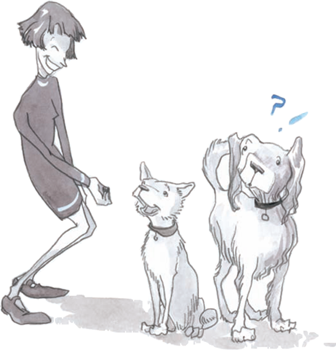
The very best way to speed up recalls: two dogs but only one treat!
Don’t Use Physical Prompting to Try to Teach Your Dog to Come
A lot of people will teach a dog to come on a long line, and of course using a leash helps to ensure your dog’s safety. So you should have a leash on your dog anytime it is likely to keep him safe and set him up to be successful. However, I strongly recommend using the leash only for safety, and not to rely on the leash to teach your dog to come. If you do so, you are setting yourself up for failure. Everything goes fine when you are doing recalls on leash—when you can drag the dog to you like a dead sea bass, you know that he’s going to come. This becomes a tremendous crutch in training, and neither you nor the dog is developing off-leash skills.

When your dog is on a long line, it is possible to safely teach recalls in public places.
Shake, Rattle, and Call

Always have a few bits of food in your pocket when your puppy or adult dog is in training. If you don’t like carrying food around, you can keep it in screw-top jars in strategic places like on the fridge, in the bathroom, or in the garden near his doggy toilet. Whenever you pass one of these jars, you can call the dog and then shake the jar. When he comes, get out a piece of kibble and give it to him. After a while, you’ll want to thin out the number of times you shake the jar after you call him and the number of times you give him a piece of food. This way, you will have a dog who comes when you call him, even if you don’t have a treat on you.
How to Guarantee That Your Dog Won’t Come
The recall is one of the easiest commands to teach but one of the quickest to trash. Many owners ruin their dog’s desire to come when called by doing one or all of the following:
- Calling an off-leash dog to come before he is trained
- Calling an off-leash dog to come before he is trained
- Calling the dog when they’re angry
- Calling the dog to be put in confinement
- Waiting to praise the dog until he gets to them
- Not rewarding the dog sufficiently
- Calling the dog to put on his leash at the dog park
Obviously, don’t do any of these things!

When a dog doesn’t come when called, first catch the dog. For his own safety, please don’t let him off leash again until you have trained him to be more reliable.

our dog isn’t going to come quickly the next time if you yell at him when he gets there. Always reward your dog when he gets to you.
Encourage your dog to check in with you frequently anytime he is allowed to be off leash in a safely enclosed area. You can clap your hands or make a kissy noise to get his attention. When he heads toward you, let him know how pleased you are and then tell him to go back and play again. You are accomplishing two important things here: checking to make sure that your dog complies and teaching your dog that coming to you does not mean the end of play, but rather a pleasant time-out for a reward.
Maintaining a Great Recall
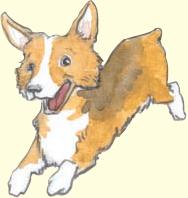
Don’t wait until an emergency to call your dog; you may find that he isn’t trained as well as you thought. Keeping your dog’s recall reliable is a top priority. Call your dog to you no less than ten times a day, every day, and vary the rewards from verbal praise to a tasty treat or a game of fetch. Remember to praise your dog every step of the way as he heads in your direction. Neglecting to praise your dog while he is in the act of coming to you is a sure- fire way to teach him not to run to you.
Walk Nicely on Leash
Pulling on the leash seems to be a very enjoyable activity for most dogs. After all, so many dogs do it! And while you certainly want your dog to have fun when taken out for a walk, you want to have a good time, too! Even a small to medium-sized dog who pulls is unpleasant and potentially dangerous, especially in the hands of a child or senior citizen. As a result, many owners walk their pulling dogs less. And when the dog is rarely walked, he is more excited than ever when he finally is walked. But once you teach your dog to walk nicely by your side, you will want to take him on lots of walks, even to places crowded with people.
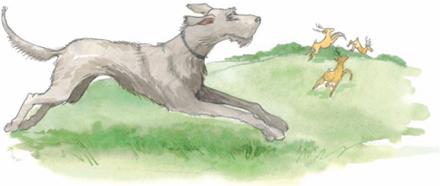
Be aware! The biggest distraction for all sight hounds (in fact, for most dogs) is a rapidly retreating critter. If you don’t yet have a reliable recall, walk your dog on leash.
Your goal is to teach your dog that whenever he’s on leash and the leash is attached to you, he should pay attention and follow you. A tight leash acts as a telegraph wire for your dog to know where you are without having to watch you, so a slack leash is what you are aiming for. Lots of people ask me if it’s okay to let their dogs pull sometimes. Many people seem to think that not allowing their dog to pull is a tragedy for the dog. If you teach your dog to walk nicely without pulling on the leash, he will be happier be- cause you will probably want to walk him more! But if you want your dog to pull you sometimes (up steep hills, for example), you can teach him to pull on command. But first focus on developing in your dog a strong habit of walking with a slack leash.
Three Points Before You Begin Leash Training
- Have at least three great rewards (toys and treats) ready to use to teach your dog to walk by your side.
2. Have at least three great rewards (toys and treats) ready to use to teach your dog to walk by your side.
3. Remember that it takes two to have a leash tug-of war. Your job is to make sure that the leash is always loose. When you do your best to keep the leash loose, your dog has to pay attention to see where you are going. If you don’t have the time or inclination to do your part to avoid a pulling game at that moment, then use a head halter to help inhibit pulling. Don’t undo all your work when you can’t pay attention to your dog. Remember, if there is tension on the leash, there isn’t much attention from your dog or from you.

Even dogs who have been bred to pull can be taught to walk nicely on leash.
Teach Your Dog to Follow the Leader
Regardless of which training method you use, teaching your dog to walk nicely on leash is much easier to do if you have first taught him to want to stay close to you when he is off leash. After all, if your dog stays by your side without you having to keep him there with a leash, then you know he wants to be there. So the first step is to play the following game. Inside your home and in safely enclosed outdoor areas, walk around and encourage your dog to follow you by rewarding him when he does with toys, praise, special treats, and his normal food. Regardless of which training method you use, teaching your dog to walk nicely on leash is much easier to do if you have first taught him to want to stay close to you when he is off leash. After all, if your dog stays by your side without you having to keep him there with a leash, then you know he wants to be there. So the first step is to play the following game. Inside your home and in safely enclosed outdoor areas, walk around and encourage your dog to follow you by rewarding him when he does with toys, praise, special treats, and his normal food. Regardless of which training method you use, teaching your dog to walk nicely on leash is much easier to do if you have first taught him to want to stay close to you when he is off leash. After all, if your dog stays by your side without you having to keep him there with a leash, then you know he wants to be there. So the first step is to play the following game. Inside your home and in safely enclosed outdoor areas, walk around and encourage your dog to follow you by rewarding him when he does with toys, praise, special treats, and his normal food.
The rules of the game are simple: Walk away from your dog and reward him when he follows. The moment you see him move in the direction you move, mark with a click or “yes” and offer a tiny treat. By walking away from your dog, you will essentially be attempting to use yourself as an enticing lure. You can also stop occasionally to encourage him to play with you or with a toy. If he doesn’t follow, do anything you can think of to get his attention. Speed up, squeak a squeaky toy, or make a clapping noise. This dog is telling you that he doesn’t find you very interesting, so liven up! You’ll both have more fun!
Use Capturing/Shaping in Leash Training
You don’t even need to say a word to teach your dog to walk nicely by your side. If you look back at the technique to teach your dog to sit, you’ll see that you can use capturing and shaping techniques to teach him to . . .
- Sit quickly
- Remain in the sit-stay
- Walk by your side without pulling on leash when you walk
. . . all in one exercise!
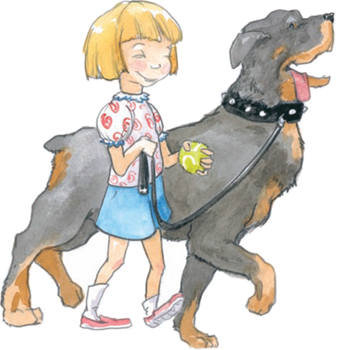
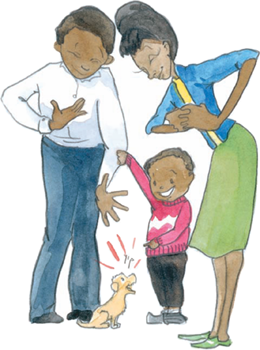
When using motivation-based training, even children can master dog-friendly dog training!
When your dog pulls on the leash and bounces all over, stop and wait for him to settle and sit. Don’t say a word. This usually takes a minute or so. He may go through a whole repertoire (pulling, barking, and circling) to get you to move. Ignore his antics and wait for the sit. Tell him “thank you” when he does sit, mark with the clicker or by saying “yes,” and give him a piece of food. Then take one step. Wait until he sits again, give him another piece of food, and then take another step.
It should take progressively less time for him to sit each time. You’ll notice how energized he gets with just one step, so don’t try to speed things up too much and take more than one step until he has done at least ten one-step sits, sitting immediately each time.
Your dog will quickly learn that watching you and staying by your side is the only way to make the walk continue and get a treat. The more he wants something (in this case, the walk or the treat), the harder he will try to figure out how to get it (in this case, by sitting).
Now that you have piqued your dog’s interest, you can move on to taking a couple of steps, and then stop and wait for another sit. Within a few days, you should be able to take your dog for a walk and stop only every 10 feet or so for a sit to reward your dog for walking nicely on leash.

If your dog pulls on leash, don’t continue to move forward, as each step you take re- wards your dog for pulling. Instead, stop, wait for your dog to come back to your side, and then continue to walk so your dog learns that sticking close by is the way to get the walk to continue.

Never drag your dog if he is scared to walk on leash. Just be patient and wait for him to move forward, and reward him when he does.
Use the Lure/Reward Technique in Leash Training
Using the lure/reward technique to teach your dog to walk by your side is simple. Hold some treats in your hand and wiggle them in front of your dog to let him sniff them. Your dog will walk by your side sniffing at the treats. Take one step forward, stop, ask your dog to sit, and, with your right hand, give him a sit signal (raise your hand up a little and toward the back of his head so he looks up and his rear end goes down). Give him the treat when he sits, wiggle your left hand in front of his nose, and take another step. Once in a while, bring the treat up to your chest and then down to the dog’s nose again so that the dog gets used to paying attention and looking up.
Repeat this exercise until your dog is a super one-step sitter. Now try taking two steps, and then stop and sit. Increase the number of steps as your dog gets the hang of it. You can soon take three steps, then four. In very little time, you’ll be able to walk all over with a loose leash, and your dog will sit when you stop. If the leash gets tight at any point, do not continue walking — by doing so, you would be rewarding your dog for pulling. Instead, stop and ask him to sit. He’ll quickly learn that watching you and stopping when you do is the way to keep the walk going.

Even a little dog has a lot of pull!
Occasionally, release your dog after he has sat at your side or walked nicely for a bit, and let him investigate at the end of the leash for a moment. This way, you are using the distractions in the environment as rewards for walking nicely by your side.
Dinner and a Stroll

Take your dog’s dinner with you when you walk your dog. Have your dog on a long leash and let him wander a few feet away from you. Call your dog, and praise him when he looks at you. Kneel down or back up to encourage him to head toward you. Praise him when he does, and give him a piece of his food when he gets to you. In a walk around your block, you should be able to repeat this process twenty to thirty times, and you will have dramatically increased your dog’s recall reliability.
Don’t Use Physical Prompting in Leash Training
Numerous leash techniques are used to train dogs to stop pulling and walk calmly. When most people think of a dog walking close, they immediately think of leash and collar training — jerking the dog this way and that to get him to stay by your side. While you can train a dog to walk close by using the leash in this way, this method is extremely deceptive. Of course, when you’re walking on public property or anyplace that might be dangerous, you want your dog on leash for safety’s sake. But I strongly advise you not to use a leash as the only training aid. If you think about it, the very notion of having to jerk the dog around is antithetical to teaching the dog to want to be close to you. Most important, what may start off as gentle physical prompting almost always turns into physical force. Eventually, most dogs become desensitized to leash corrections and end up pulling more vehemently. So do not rely on using the leash for corrections to get the dog to come close or keep close.
Come and Get It!
Have a friend or family member hold your dog in another room while you prepare his meal. Call your dog (tell the person to let go when you do so), and reward him for coming to find you by giving him his meal.
What If My Dog Won’t Walk?
Nothing will make your dog balk and want to move away from you more than jerking the leash and dragging him. If your dog lags, be careful not to reinforce this behavior by giving him attention when he stops. Instead, stand or kneel facing away from your dog and wait. Praise your dog if he moves even one inch toward you. It doesn’t matter how long it takes (it shouldn’t be more than a minute or two) — eventually he will come. Then walk another few feet away and repeat if he stops.
The Tie That Binds: Umbilical Cord Training

Leaving a young or new dog to explore the house on his own is asking for trouble. Even being in the same room as your new dog may not be sufficient supervision. It takes very little time for a dog to chew a piece of furniture or soil the carpet. Occasionally tying your dog to you (around your waist) is an effective way to allow your dog to spend time with you around the home under safe and constant supervision when he is not resting in his long-term confinement area. As a bonus, within a few days, your dog will develop the habit of walking by your side around the house and settling at your side when you stop. This is a terrific foundation for walking nicely by your side on leash outside.
If your dog is afraid of leash walking, take him out for numerous confidence- building training sessions on leash. You don’t want to take him with you on an er- rand when you may be in a hurry and get frustrated with your dog. Once you have taken the time to teach your dog to enjoy leash walking, he can come along with you on all your errands.