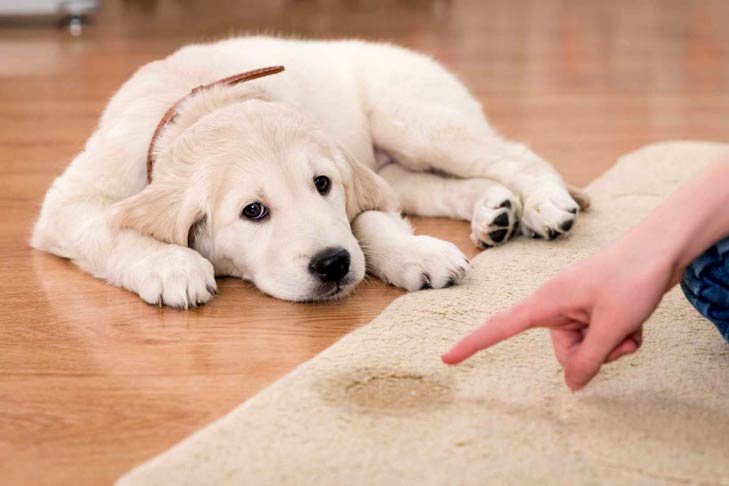
One of the first things you need to do in house training is choose where you want your dog to eliminate. There are three basic options for your dog’s toilet: outside on grass or concrete, inside on a doggy toilet, or both inside and outside. Having an adult dog who is trained to go inside on a doggy toilet in addition to outdoors can be very convenient and is often the choice for owners of small dogs.
House training Puppies versus Adult Dogs

The only difference between house training a puppy and house training an adult dog is time. Pups generally take a little longer because of their limited bladder and bowel muscle control. Consequently, puppies need to go more frequently and therefore require more diligent time management and more frequent trips to their doggy toilet (at least once every hour or two for very young pups under 10 weeks of age).
Indoor Potty Training
If you have a young puppy and you can’t be home to take him out as frequently as necessary during the day, then use a temporary indoor toilet. A very young puppy needs to go to the bathroom so often (just like a human baby) that it is inconvenient for most people to have to take him out often enough (especially if you live in a high-rise apartment). If your schedule permits, however, you can avoid using an indoor toilet simply by taking the pup outside as frequently as you think he needs to go.
Paper or Pad Training
If you choose to use papers or specially designed pads to train your pup, cover the entire floor of his long-term confinement area with paper or pads so that he can’t make a mistake by going off of it. Don’t assume that your pup will know to target a small area of paper or pad. Even if he does so at first, this doesn’t necessarily indicate that it will remain a strong habit. It is best to set up your pup for success by covering the whole floor for at least a few days until you are confident that he has developed a strong preference for eliminating on your chosen surface. Every few days, remove a sheet or two until you are down to a small covered area. If he misses the paper or pad, then you have taken up too much too fast, and you should go back and cover more of the floor. Obviously, you will want to replace the paper or pads several times a day, so stock up!
Set Up Your Dog for Success

Your top priority when house training your dog is to do all you can to set him up to be successful. Every opportunity you give him to make a mistake sets him up to fail. So use a little tough love and be diligent about the wise use of all the management tools so that he has the best chance of being house trained as fast as possible.
A Smooth Transition from Indoors to Outdoors
Ideally, it is a good idea to have an indoor doggy toilet that has the same surface as the one he will eventually use outside. Most people try to house train young pup- pies by teaching them to go on paper or pads and then outside on grass or concrete. But switching surfaces (from paper or pads to grass or concrete) when the dog is 3 to 4 months old means that house training is a two-step process: first teaching the dog to go on one surface inside and then on another surface outside. If you intend for your adult dog to have an outdoor toilet, bring a little bit of the great outdoors into your home. Get a roll of grass sod or a thin slab of concrete and place it in a large plastic litter box or a motor oil drip pan. If you choose to use grass turf or concrete in a litter pan, simply confine your pup to an area that is small enough that the pan takes up most of the area (aside from his bed). This arrangement may sound a little strange, but it will make house-training all the easier. You will need to replace the grass or concrete at least once a week. Unless you want your dog to be litter-box trained in the future, you will use this indoor doggy toilet only until the puppy is old enough to control his bladder and bowel movements for longer periods in his crate.
If you must use a temporary indoor toilet in a long-term confinement area, be sure to use every opportunity (evenings and weekends) to get your pup to learn to hold it in his short-term area so that you can take him to the right spot outside to eliminate. This way, you are helping your pup strengthen his bladder and bowel muscles, and you can make an easier transition to getting him to go outside quickly, consistently, and permanently in the future.

A roll of turf is a marvelous innovation for a temporary indoor doggy toilet. It will speed up house training like you won’t believe.
Quick Tips for House training
- Give your dog every opportunity he needs to eliminate in the place you have chosen as his toilet.
- Praise and reward him lavishly when he goes on his doggy toilet.
- Give him zero opportunity to eliminate anywhere other than his designated doggy toilet.
Outdoor Potty Training
Teaching your dog to eliminate outdoors may require some patience if you expect him to eliminate on an unfamiliar surface such as concrete. This is especially true if you live in a city and your puppy or dog is not yet familiar with the sights, sounds, and smells, which can be overwhelming for some dogs.
When you take your dog to his outdoor doggy toilet, start by teaching him this new behavior at times when you are most sure he needs to eliminate. The best time is usually first thing in the morning.
Don’t make the mistake of trying to walk your dog around the block to get him to go. Usually, this prolongs the process because your dog will get distracted, and some dogs who like to walk learn to hold it because they learn that the walk ends the moment they go. Instead, teach your dog to go to the bathroom right when you take him outside to a designated spot. Then the walk can be a reward for prompt elimination. On a cold and rainy night, you will be glad that you taught your dog to go quickly!
Walk back and forth in one area that’s about 10 feet long, and wait about five minutes for him to go. If your dog doesn’t go within five minutes, go back inside, keeping your dog on leash and on your lap (if possible). This is especially important with a puppy, whose bladder control is not yet very good, because you want to prevent a mistake. Sit down and read or watch television for ten to fifteen minutes before going back out to try again. This process usually takes no more than two or three attempts. Once your dog is rewarded with tasty, tiny treats and praise, he will start to understand what is expected when you head outside. Your dog is likely to go more and more promptly each time he is rewarded for doing so.
Perfect Aim

If you don’t want your dog to use the whole yard as a toilet, you can train him to relieve himself in a specific area. Dogs are very particular about where they eliminate, so it is easy to teach a dog to go in a specific spot. Use posts and/or string to create a boundary. Take your dog on leash to this spot and reward him with a special treat for going there. In no time, he’ll head straight for his special spot as you go out the door.