There are two objectives in training your dog: a major objective and a minor one. The major objective of friendly, intelligent pet dog training is to teach dogs to do things we want them to do. The secondary and minor objective is to teach dogs not to do things we don’t want them to do.
Dog-friendly dog training zeroes in on the major objective: teaching your dog what you want and rewarding him for doing it. This is the easiest way to train your dog. After all, there aren’t many things we consider “right” for pet dogs to do, so you really don’t have many things to teach. On the other hand, the list of “wrong” things that pet dogs can do is endless, so trying to train by punishing your dog for each mistake would be a lengthy and unpleasant process for both of you. When you have taught your dog to reliably understand you and consistently spend his time focusing on good behaviors, he won’t have the time or the inclination to be- have inappropriately.
For any natural dog behavior you can come up with, there are lots of inappropriate choices and usually just a few correct ones. For example, imagine the one right spot for your dog to use as his toilet (either outside or inside on papers or pads), and imagine how nice and easy it is to take him to that spot when he needs to go (and reward him for doing so).
Teaching Right Is Easier Than Teaching Wrong

Rewarding good behavior is the central tenet of dog-friendly training. Choosing to focus on rewards rather than punishments is the most important decision you will make with respect to educating your dog. Not only is doing so more fun — for you and your dog! — but it is also much easier. After all, there is a rather short list of right behaviors, but an almost endless list of wrong ones.
“Right” Behaviors
- Eliminating in appropriate spot (s)
- Playing nicely with people
- Playing nicely with other dogs
Playing with dog toys (especially food-stuffed chew toys)
- Responding to your requests (to sit, lie down, come, etc.)
- Resting calmly indoors
- Sitting to greet people
- Walking nicely on leash
“Wrong” Behaviors
- Eliminating in the house (in hundreds of different spots)
- Playing roughly with people
- Chewing on your clothes
- Chewing on your furniture
- Chewing on your plants
- Chewing on your shoes
- Chewing on your toys (CD’s, books, the remote)
- Chasing the cat
- Digging in your garden
- Eating your food off the table
- Fighting with other dogs
- Guarding objects
- Jumping up on visitors
- Not responding to your requests
- Pulling on the leash
- Raiding the garbage
- Running away
- Barking for long periods
- Add your dog’s annoying behaviors here:

You’ll have a whole lot of cleaning up to do after you’ve allowed your dog to test out all the wrong places to go to the bathroom.
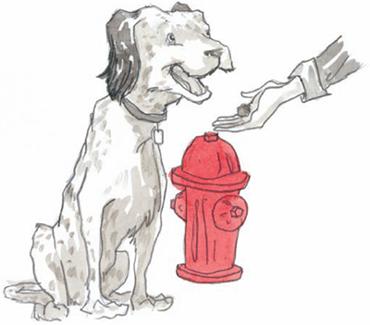
Teaching your dog the one right spot to go to the bathroom is much easier than punishing him for going in innumerable wrong places.
Now imagine the hundreds of wrong places for him to urinate and how long it would take and how unpleasant it would be to punish your dog for going in each of those spots. Likewise, picture your house after your dog has tried out all the wrong things to chew. Now imagine how much easier it would have been if you had just gotten him hooked on a chew toy or taught him the one appropriate place to eliminate.
Catch Your Dog Doing Something Right!

It may be human nature, but we tend not to notice or to ignore good behavior and instead focus most of our attention on behaviors we don’t like. Try to catch your dog doing something right at least five times a day and reward him for doing it. You’ll find that each day it will be easier and easier to do so, because your dog will be learning the best ways to get your attention. For example, if he walks up to you and sits in front of you, let him know how pleased you are that he chose such a polite and friendly way to say hello. The more frequently he offers the right behavior, the less time he’ll have to do the wrong things.
Why else is rewarding good behavior so important? For the simple fact that once you have successfully taught your dog how you would like him to behave, he will no longer misbehave. And when he doesn’t misbehave, you have no reason to be upset with him. Do yourself and your dog a favor and start teaching your dog what you want him to do the first day he comes home with you. If you already have a dog, start today!
The principle of teaching what is right makes special sense during puppy hood. Not even twenty years ago, it was impossible to enroll a dog in obedience classes until he was at least 6 months old. This would be comparable to keeping children out of school until their late teens! By 6 months of age, most of those uneducated dogs were seriously out of control and required physically rigorous and mentally demanding training methods.
Thankfully, times have changed. Puppy training is widely available, and trainers, veterinarians, shelter workers, and breeders encourage new dog owners to begin teaching their dogs on the day they take them home.
Managing Unwanted Behaviors

Dog-friendly trainers focus on getting rid of unwanted behaviors through preventative management and lack of reinforcement. For example, if you keep your dog on leash when greeting people at the front door (preventative management) and nobody reinforces jumping (lack of reinforcement), your dog won’t be able to practice the behavior, won’t find the behavior very re- warding, and will try to figure out what behavior is rewarding. He is likely to try sitting as a way to get attention, at which point you should reward him to make this the greeting behavior he chooses in the future.
If the unwanted behavior persists, try to figure out what is reinforcing it. Sometimes the behavior itself is reinforcing, as is the case with some dogs who seem to get a thrill out of barking. In this situation, focus on providing your dog with more exciting activities than barking. How about giving him every morsel of his meals from food-stuffed toys so that he is kept busy working to get his food out? Or how about using management tools such as on-leash supervision or confinement to a specific area to prevent access to the most stimulating areas of your home (doorways and windows) until he has learned that excessive barking is not appropriate?