Jumping Up

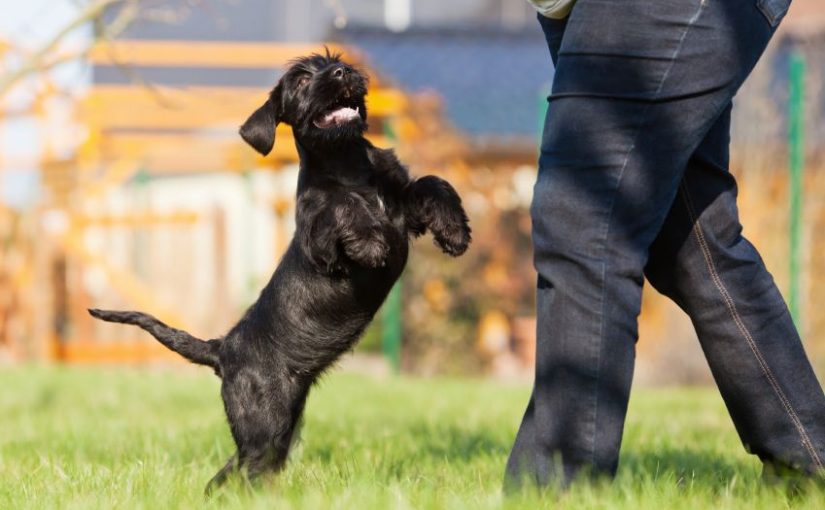
Dogs jump on people to say hello in an effort to be friendly, and because many dogs have not learned the requisite impulse control to manage their exuberance. Although you want your dog to be friendly with people, her excessive enthusiasm may keep friends away and make all that wonderful socialization go to waste. Your dog deserves to be taught how to greet people properly so that she can enjoy the pleasure of human company. 

Frequently, dogs are reinforced for jumping up during puppy hood. It can be quite charming for a little pup to bound up to us enthusiastically and jump all about. However, reinforcing this behavior really isn’t fair to the pup, since it is unlikely that the behavior will be deemed appropriate once she is a grown-up dog. 

Most adult dog jumping occurs when owners come home feeling guilty for having left the dog and in some cases are actually somewhat pleased that the dog is so happy to see them. Jumping up is also frequently reinforced by people outside your family who respond to your dog out of nervousness or embarrassment or because they don’t really mind the jumping since they don’t have to live with it long-term. But you do! 
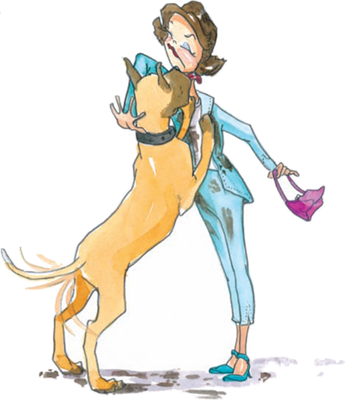
Understandably, most people would prefer to be greeted by a dog who has been taught to sit to say hello. 
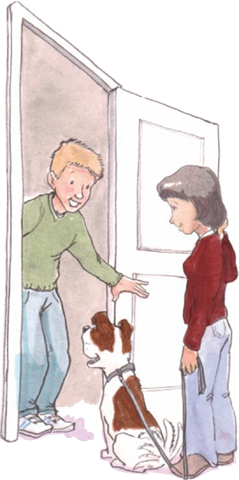
Until your dog learns good greeting manners, keep him on leash so that you can man- age and prevent inappropriate encounters, such as jumping.  

Teach your dog to stand or sit to greet people and you won’t have to worry about her jumping. Most important, focus on managing your dog by keeping her on leash when she greets people until she has learned how to greet politely. 

You can begin using the capturing method by simply waiting for your dog to sit and ignoring everything else she does, whether it be bouncing around or barking. The moment her rear hits the ground, say “yes” or click and offer a tiny treat. Tell her “okay” (or say whichever release word you’ve chosen) so she knows that she can get up, and then take a step away from her so she follows you to “greet” you again. Wait for the sit, and then mark and reward it. It shouldn’t take long for her to learn that sitting is the way to get rewarded. 

When she sits automatically when you stop, you’re ready to progress to more difficult greetings. Take a few more steps between sits — the more you move, the more likely your dog is to get revved up. You can also try being verbally playful with her once you stop walking. Gradually increase your enthusiasm, and eventually you should be able to be as playful as you like, and your dog should respond with an equally happy, but seated, greeting. 
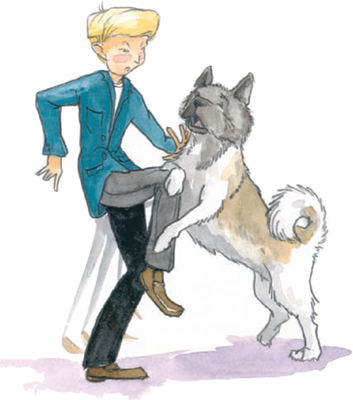
This dog may learn not to jump up, but she may also learn that she doesn’t want to greet people at all. 

When you think that your dog is ready, have family members enter the front door numerous times during three- to five-minute training sessions, and then try inviting a few friends over. Have your dog’s meal or special treats ready. For each person who comes to the door, simply wait for your dog to sit, and then give her one piece of her food. If each person is kind enough to leave and come back ten times, you’ll have thirty practice sessions by inviting just three people over. If you want to speed things up a bit, lure your dog into a sit. 

People have devised all sorts of ways to physically punish dogs for jumping up, such as jerking the leash, holding the dog’s paws, stepping on the dog’s hind feet, kneeing the dog in the chest, and flipping the dog over backward. Why not just train the dog to greet people appropriately? Why not train her to sit? 

When an overly enthusiastic greeting is met with a physical punishment and/or a verbal correction, the dog may be left thinking, “I just wanted to say ‘hi.’ Wow, they must be angry at me. Let me try and make up by greeting them happily again.” Indeed, punishment often prompts your dog to jump up with renewed vigor, for which she is then met with a more severe punishment. The act of greeting people now becomes a confusing prospect. Some dogs with softer temperaments may be so confused and panicked that they begin to urinate when greeting people. What the owners perceive as a disgusting behavior is actually a way for the dog to say how submissive she feels in the face of potential punishment. 

Chewing Inappropriate Items

Dogs are superbly investigative creatures who use their teeth (since they don’t have hands) to hold and manipulate things. It is normal for dogs to pick up objects and carry them about and, oftentimes, to find spots to store those objects. 

Puppies are especially likely to use their mouths to investigate and chew objects because they are programmed to learn as much as possible about the world in a very short period. Young puppies also go through the painful process of teething as they lose their baby teeth and adult teeth grow in their place. Chewing can help alleviate the pain of teething. 

The most important strategy in preventing the chewing of inappropriate items is to provide your dog with plenty of appropriate chew toys. I recommend toys that are hollow and can be stuffed with food. Also, don’t allow your dog to have too much freedom in your home before she can handle it. It is advisable to keep her on leash when you can supervise her. Avoid playing roughly or otherwise encouraging the dog to nip at hands, clothing, hair or inappropriate objects. 

Couch Hog

Many dogs learn to see soft, comfortable areas to rest (such as your couch and bed) as valuable places that they are unlikely to relinquish readily. If you choose to permit your dog to share these resting areas with you, be sure to use preventative measures in order to avoid the unpleasant situation of having a dog who won’t get off when asked. In the worst-case scenario, a dog may growl, bark, or bite when asked to move. If this is the case, seek the assistance of a professional trainer immediately. 

The goal is to teach your dog that when she leaves a desirable spot at your re- quest, good things are likely to happen. Start with the dog on the floor as you sit on the couch. Encourage her up onto the couch. If she isn’t big enough to jump up, you can use a pillow or two or give her dog steps to step on. To get her to jump off the couch, pat the floor and encourage your dog to jump off. Click or say “yes” when she does and give her a tiny treat. It won’t take her long to realize that getting up on the couch isn’t so exciting, but jumping off when you ask her to is terrific! 

Separation Issues

Dogs are social creatures who don’t like to be left alone. Sadly, most pet dogs spend a large part of their time by themselves. To prepare your dog to enjoy time spent at home alone, make sure that she frequently spends time by herself while you’re at home. You don’t want to set a precedent of constant companionship — this just sets your dog up to fall apart when you leave. Some dogs react to being left alone by indulging in their favorite pastimes. These might include being destructive to the home, barking, or marking the house with urine and feces. 

Many owners have difficulty ignoring their dogs during the course of the day, especially when their dogs seek attention. Interacting with the dog almost constantly becomes a habit. Instead, try using a crate or tie-down. A tie-down is a leash that can’t be chewed through that you attach to a stable object or an eye hook in the wall. The tie-down should be only about 3 feet long, just long enough for the dog to sit, lie down, stand up, and turn around. It is sort of like a crate without walls. Put a couple of food-stuffed toys in your dog’s crate or by the tie-down to give her something to do while she spends time alone.

Garbage Raiding

Dogs are naturally investigative creatures; like many of us, they are always on the lookout for a tasty morsel. Therefore, it should come as no surprise that your dog might try to figure out a way to gain access to the garbage, which is surely full of delicious leftovers. 

To discourage garbage raiding, get a garbage can that has a locking lid. Or simply put the garbage can in a place your dog can’t reach, such as under the sink. If you attempt to correct your dog when you catch her raiding the can, chances are all she will learn is to avoid going on a garbage hunt when you’re around. You’ll essentially have created an owner-absent garbage hound. 

Eating Feces

Eating feces is a distasteful habit that many dogs will engage in if given the chance. Most commonly, dogs will eat the stools of other animals. Less commonly, dogs may eat their own stools. 

The most likely cause of this habit is boredom. However, some experts suggest that it may be caused by a nutritional deficiency, so make sure that your dog’s diet is well balanced and speak with your dog’s veterinarian to rule out this possibility. 

The solution to feces eating starts with preventing your dog from having the opportunity to practice this behavior. Each time she does it, the habit becomes stronger. If you are walking in the woods with your dog, simply call her away from any stool and reward her with a treat. If you let your dog out in the yard to eliminate, go with her and clean up her stool promptly. 

Some people have had success with food additives designed to make the stools distasteful. More important, be sure to provide your dog with plenty of chew toys to keep her busy. 

Digging

Your dog has lots of reasons for wanting to dig. Digging is fun and relieves boredom. It also creates a cool place to lie in hot weather, and in some cases dogs dig to escape an enclosure. To prevent unwanted digging, don’t let your dog spend unsupervised time in the yard. Go outside and watch her play or, better yet, play with her. If you can’t supervise, bring her indoors. 

If you don’t want to ban digging altogether, you can teach your dog that it isn’t digging you dislike, but digging everywhere. Choose one spot and designate it as her digging pit. Think of it as her sandbox. Let her watch you bury a couple of tasty chew toys. Then encourage her to dig in that spot to get them out. Your dog will learn that this is the best (and only) place to dig, because it’s where the buried treasure is and because you are there to help her choose the right spot.

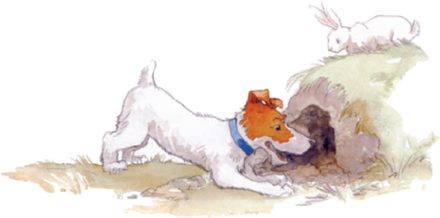
Terriers dig? Of course they do! Terrier comes from the word terra, meaning earth. Terriers were born and bred to dig. 

Hyperactivity

It’s all too common for dog trainers to hear owners describe their dogs as hyper- active. In fact, most of these dogs aren’t really hyperactive; they just have the typical energy level of a dog (high) and are in a home where the owner has the typical energy level of a person (not quite as high as a dog, especially after a long day at work). 

The simple solution to this “problem” is to make sure that your dog:  

  • Has adequate exercise. Talk to your vet about your particular dog’s needs.

  • Is fed the appropriate food. Food affects a dog’s behavior, just like it does with people.

  • Is mentally stimulated. Hide lots of fun, educational toys, such as those that can be stuffed with food, around the house.

  • Is taught to have an on/off switch. Many times throughout the day, play with your dog and get her into an energetic mood. Interrupt the play many times by asking your dog to lie down. To begin, ask her to lie down for just a few seconds before you release her, and then gradually increase the length of time you expect her to control herself and remain lying down. Continually getting your dog excited and then settling her down turns what could be a problem (an excited, high-energy dog) into a reward for calm behavior. This is a perfect example of a life reward: using something your dog likes (high- energy play) that is not concrete (not a treat or praise) to reward her for behavior that you like (lying down calmly).

Chasing

Chasing other animals and objects is a great thrill for many dogs, especially sight hounds and herding breeds. These dogs were bred specifically to chase and are likely to be highly stimulated by cars, bicycles, moving animals, and joggers. Chasing is basically an extension of the dog’s prey drive. Although this behavior is normal and natural, it can lead to trouble in many ways. A dog who chases can become a neighborhood nuisance and, worse, can cause serious injury to herself, an other animal, or a person. If your dog has a habit of chasing, keep her on leash at all times when outdoors until you are confident that you have resolved the issue.

One of the most important aspects of preventing and resolving chasing issues is to teach your dog to come reliably when called (see page 174) and to hand target for attention (see page 191). When appropriate, it is also important to set up prac- tice sessions with whatever is stimulating your dog to chase. For example, if your dog chases people riding bicycles, invite a friend over to work on conditioning your dog to remain calm and under your control when your friend passes by on the bike. 

Plan three- to five-minute sessions at times when your dog is hungry so that you have the best chance of attracting and keeping her focus, and be sure to keep her on leash. Always start at a distance far greater than what you think your dog can handle. Perhaps you need to have your friend pass by at twenty feet away in order for your dog to be able to focus on you. 

Practice hand targeting, sit, down, stand, and any other skills you have taught your dog as a way of instructing her to focus on you and respond reliably to your requests. It is important to confirm that your dog responds reliably to requests in a stationary position before you can expect her to respond to you (and come back when called) when moving away from you at a distance. 

Gradually decrease the distance between your dog and the bicycle (or whatever stimulus you are working with) when you feel that your dog can handle it. Because this closer range will be more challenging for your dog, be sure to increase the value and frequency of the rewards you give her. 

Fear of People

Reward-based techniques are the method of choice when dealing with fearful dogs. If you have a dog who’s a little afraid of or doesn’t like people, you need to find a way to get this message across to the dog: “Hey, buddy, I like you. If you’ll just come close, I’ll give you a bit of food or a toy.” Using food as a lure is an effective way to communicate when the dog is afraid of your voice or physical contact (in which case you cannot praise or pat), and it’s easy to toss a piece of food to the ground close by. Eventually, the dog will come closer, lured by the food first on the ground and then in your hand. 

Make sure that your dog is extremely interested in food by starting this exercise well before mealtimes or as a substitute for them. Sit in an armchair and scatter food around you (or a friend). Your dog can approach and retreat as she likes. As she comes closer, she gets the food, and as she runs off, she gets nothing. Once she is more interested in the food (this may take some time depending on how fearful your dog is with a particular person, so it’s best to focus on proximity first), you can take the food and talk gently to the dog in the language she has learned: come, sit, and down. This in itself is like a behavioral pacifier and will accelerate the bonding process. That is, if your dog is confident in her understanding of what is expected when asked to sit or lie down, her overall confidence may improve. This clarity means that it is easier for the dog to remain calm and focused on what to do to get a treat.  

A Tiny Touch Can Lead to So Much! 

Teaching your dog to hand target is an invaluable aid in resolving fear is- sues. The more she is rewarded for touching her nose to the hand of a variety of people, the more her confidence in and enthusiasm for people will improve. 

If you think your dog is fearful, stressed, or worried, for your dog’s sake please work on this problem before it worsens. Being anxious is no fun. If your dog has any kind of aggression problem, seek help from a professional trainer immediately (call 800-PET-DOGS or go to www.apdt.com).

Don’t Be an Overprotective Owner! 

Avoid being overly protective of your puppy or dog, especially if you have a little dog. More often than not, overprotectiveness creates or exacerbates fear and aggression problems.