
Puppies in a litter spend a lot of their time nipping at each other, so it is no surprise that your pup may think this sort of normal dog play is all right with you. But, just as your puppy must learn to inhibit his bites with his canine playmates (if he hurts his friends, they won’t want to play anymore), so must he learn to inhibit the use of his mouth with humans. In fact, learning to inhibit his formidable weapon is one of the most important lessons your dog will learn.
Surprisingly and luckily, the more your puppy bites you when he is very young, the better his bite inhibition is likely to be as an adult. Each time your pup bites is an opportunity to remind him how sensitive human skin is. On the other hand, a puppy who never bites humans can’t learn how sensitive human skin is and how careful he must be.
With this is mind, don’t attempt to tell your puppy to stop biting by yelling at him, grabbing his muzzle, or otherwise hurting him. Doing so may quickly stop the biting (for the moment) by scaring him. But imagine that one day your dog does bite someone, maybe because that person accidentally stepped on his paw. If this happens, it is essential that your dog cause as little harm as possible. You want a dog with superb bite inhibition. So the first thing to teach your pup is that human flesh is very sensitive, much more so than his litter mates’ skin. Your puppy should think about how careful he has to be when play-mouthing with you. Then you can work on curbing mouthing altogether.
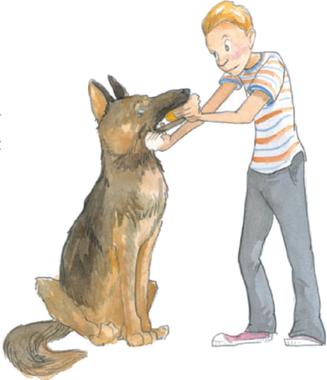
Don’t try this at home! Your dog can be trained to give on request.
Start by playing with your puppy only when he has a leash on. If you play with your puppy when he is off leash and he nips you, you have no way to gain control of the situation unless you grab for your pup. This will most likely get him even more riled up (most pups love to be chased), and it may teach him to avoid you (if you reprimand him when you do catch him) and potentially teach him to avoid being grabbed —something you will regret if your dog ever gets off leash on the street by accident.
Keeping the dog on leash is especially prudent for children, who can play with a puppy when supervised. This is the perfect way to prevent nipping, jumping, and overly exuberant play. You can also tether the pup to a stable object so that the child can get up and walk away without the pup being able to practice chasing and nipping.
When your puppy goes to bite you, respond with a time-out by standing up (if you are in his long-term confinement area), using his leash to hold him gently at arm’s length, or stepping on the leash so he can’t move about and play. Wait a few moments, and then try playing again. The force of your pup’s next nibble should come down a bit. If not, give another on-leash timeout or tether the leash to a stable object and walk a foot or two away.
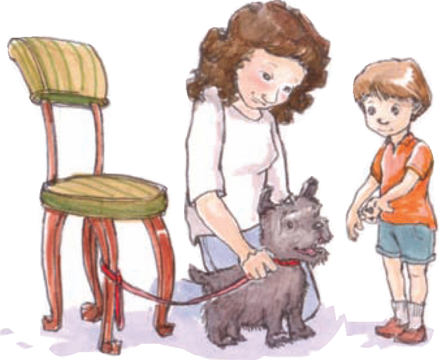
Until your dog learns to play calmly with children, practice supervised play/training sessions with your dog on a leash so he remains stationed and calm.
Simply ending playtime is an effective punishment for many puppies, since now your puppy has nothing and nobody to play with. You want him to think how boring it is when you stop playing with him (because he nipped you). This momentary social banishment is very effective. You are essentially telling your puppy that you will not play with him if he isn’t careful with your skin.
After a week or so, the next step is to teach your pup to stop mouthing altogether. Some puppies will naturally decrease the frequency of their nips, especially when you have taught them to inhibit their force. When your puppy is 3 to 4 months old, it is time to teach him that he should not use his teeth on people at all. Using the same principle as when teaching bite inhibition, simply respond to any teeth on your skin (no matter how soft) with an end to the play session.
Don’t Fight Fire with Fire
If your dog nips you, don’t yell at him or go face to face to correct him. A hostile response might escalate the confrontation, or it might teach your puppy to hold back and wait to bite someone who isn’t able to use force or scare him enough to stop (like a child). Certainly, don’t grab for your dog’s muzzle to correct him. This will only teach him not to like hands reaching toward his face.