
Puppy Socialization and Habituation
Although you can obedience-train a dog at any age, a sound temperament is some- thing that should be nurtured and improved upon early in life. If you delay this process, you can still socialize your adolescent or adult dog, but it will be much more time-consuming, and you could be playing catch-up for years to come.
Watchdogs Are Friendly, Too!
Some people resist socializing their dogs to strangers because they want their dogs to be protective. Your dog’s innate ability to choose between friend and foe might be pretty accurate, but eventually she may make a mistake. It’s much smarter to socialize your dog first so that she is confident and secure in the company of all people. Then, if you choose, train your dog to bark or growl on cue as a protective ruse.
The concept of early socialization and puppy training was rediscovered and popularized by dogs’ best friend, English veterinarian and behaviorist Dr. Ian Dunbar. No other training innovation has had such a dramatic influence on the lives of pet dogs and their owners around the world than this one. Early socialization is the best way to create your perfect companion and to avoid behavior and temperament problems.
Certainly, puppy-training concepts are not new. In fact, they’re so old that they’re new again! Both dog and horse texts from the 1800’s talk about early training and gentling procedures, but many of these concepts were lost to the world of dog and horse trainers for the greater part of the twentieth century. However, the word has spread, and puppy socialization and training are at the forefront of modern dog lovers’ agendas. In fact, you can find puppy playgroups, puppy-training classes, and adult dog socialization groups in just about every town and city. Thanks to Dr. Dunbar and others like him, the socialization revolution has been very successful!
A Puppy’s Development
An understanding of the developmental stages a puppy goes through in the first few months of her life is valuable whether you are working with a young pup or an adult dog. In either case, it’s important to consider that these early weeks are the foundation for her behavior for a lifetime.
Birth to 21 days:
During this period, the puppy has an extremely limited mental capacity and reacts only to her needs for warmth, food, and sleep. At the end of this period, the pup’s eyes begin to open, and as a result the pup begins to respond to movement and sounds.
21st to 28th day:
During this time, the puppy’s brain and nervous system begin to develop rapidly. At this stage, the pup has a greater sense of awareness and is strongly affected by conditions and experiences.
5th to 7th week:
At this stage, the puppy is likely to begin to explore her surroundings and develop a greater social awareness of both her litter-mates and any people she is exposed to (especially in regard to recognizing voices). A social order within the litter starts to establish itself; it is most obvious at feeding times, when some pups fight confidently for food (the pups begin biting), while others wait passively. The pups’ mother begins weaning them and teaching them basic manners, especially in regard to taking food gently from her. If they are too rough, she will get up to walk away.
8th to 12th week:
The pup’s ability to learn is at full capacity by this point. It is crucial to take advantage of this period so that you can make the most of your pup’s ability to learn so much in such a short time. Your pup’s bladder and bowel muscles are starting to develop, and some pups at this age can sleep through the night.
13th to 16th week:
During this period, the puppy is likely to begin asserting her- self and displaying greater independence, much like a toddler. It is especially important to control resources (food, toys, attention, and the environment) so that they are useful as tools to teach your pup to behave politely, especially in regard to curbing nipping. During this period, the puppy is likely to begin asserting her- self and displaying greater independence, much like a toddler. It is especially important to control resources (food, toys, attention, and the environment) so that they are useful as tools to teach your pup to behave politely, especially in regard to curbing nipping.
17th to 24th week:
At this stage, the puppy is much like a 13-year-old child. The pup is likely to demonstrate greater independence and may seem to be challenging you every step of the way. She is coping with the pain of teething as well as the hormonal changes that result from moving toward sexual maturity.
25th to 72nd week:
During this period of young adulthood, the pup is likely to be full of energy and exuberance. It is crucial that you continue to help her focus that energy in positive ways and improve her understanding of how you want her to behave so that she can mature into the dog of your dreams!
Getting Used to Sounds
It is vital to expose very young pups to a variety of noises, especially during the first few weeks of life, as their ears are opening. This exposure enables developing pups to become accustomed to loud and potentially scary noises in a gradual fashion. Getting accustomed to many different sounds is a key ingredient in creating a dog who gets to experience and enjoy lots of social situations throughout her life.
When familiarizing a puppy with various sounds, perhaps the most important precaution you can take is to ensure that the puppy has been raised indoors — not in a barn, not in a kennel, but inside a home, which is where you will want her to be with you for her whole life. Ideally, she will be situated in an area where she has exposure to the comings and goings of the household. This precaution is especially important with sound-sensitive breeds, such as guarding breeds. If you have done your homework and have chosen a pup who has been raised inside a home or in a shelter that provides an enriching environment, then you know she is already off to a good start on her journey down the socialization highway! But don’t fret if you are adopting a puppy or an adult dog and don’t know her background. Simply do your best to expose her to a host of normal, everyday noises in her new home. So no tiptoeing around this little girl. Turn up the radio, open the windows, and start vacuuming!

Turn on the TV to help your pup get used to lots of noises, and you might find that you have the same favorite shows!
Habituation Checklist: Getting Used to Sounds
✓ Children playing (shouting and screaming, but not poking, prodding, or other- wise manhandling the pup)
✓ Doorbells
✓ Hair dryers
✓ Lawn mowers
✓ People knocking at the door
✓ People yelling
✓ Radio
✓ Storms
✓ Television
✓ Traffic (motorcycles, street-sweeping trucks)
✓ Vacuum cleaner
Getting Used to Surfaces
Some dogs are very sensitive to particular surfaces and will do all they can to avoid walking across them. You can prevent such issues by gradually exposing your pup to various surfaces right away. Praise, food, and toys can be useful motivators and rewards when teaching your dog to be comfortable on varied surfaces.
Habituation Checklist: Getting Used to Surfaces
✓ Ceramic tile
✓ Grass
✓ Gravel
✓ Ice
✓ Mud
✓ Stairs
✓ Wood flooring
✓ Other slippery surfaces
Make Your Dog a Social Climber
Climbing the social ladder can be tough for people, but you can have a whole lot of fun helping your dog climb her social ladder. Let her experience as many things as possible in a rewarding setting so that she becomes a confident and well-adjusted member of your family. The earlier you start, the better. By 16 weeks, your puppy’s view of the world and her place in it has already become well established, but it is never too late for your dog to become better equipped socially.
Getting to Know People
To keep up with her developmental timetable, your puppy needs to be well on her way in regard to socialization with people by the time she is 4 months old. As a general rule, your pup needs to have met at least fifty different people in a positive setting. Fifty people by 4 months old? Actually, it’s easy. All you have to do is invite people to your home and have a few puppy parties!
Some people have told me that this is an unrealistic demand to make of a new puppy owner. But again, nothing is more important for a pet dog than to be well socialized and friendly. And there is no better time to lay the foundation than in early puppy hood. Investing time and energy in this process early on will save you a whole lot of time and energy (and probably grief) later on. Anyway, socializing your puppy is fun! Put the word out to your friends that they can come and play with your new dog, and chances are you’ll have to throw a few little parties a week to accommodate them all! If you can find a puppy class in your area, all the better.
Helping Your Pup Gain Confidence
If your puppy or dog shows signs of stress when exposed to something, let her gain confidence gradually in well-planned training sessions. Be prepared with plenty of high-level reinforcers (your dog’s favorite treats and toys), which you can offer while she is at a safe distance from the thing she is scared of and gradually make closer contact. Don’t try to force the situation or accidentally encourage the fearful reaction by saying something like “Poor puppy!” This well intentioned attention is likely to make the problem worse.
Puppy Parties
If you want a dog who is friendly with people and other animals, you must begin socializing in puppy hood and maintain socialization throughout the dog’s life. There is no better way to introduce your dog to numerous people in pleasant and rewarding settings than to host puppy parties in your home or at a local training school or veterinary practice.
Initially, invite close family and friends, and teach them all to use tiny bits of food (you can use your dog’s normal meals or special treats) to teach your dog to come, sit, and lie down. Not only will your friends train your dog for you, but your dog also will learn to love people. Be sure to invite women and men, as well as children, a few at a time.
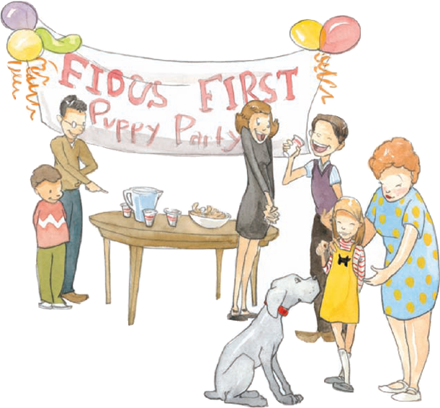
Puppy parties are the best way to improve your dog’s social life — and yours, too!
Once the puppy is thoroughly at ease with all sorts of people, it’s time for a little frivolity. Have costume parties where everybody wears a hat, carries something unusual, and adopts silly mannerisms. This might sound a little ridiculous, but it’s for a serious reason. Basically, after a series of puppy parties like these, little in the real world will really scare your dog. For example, if a child who has dressed up for Halloween as a frog hops by your dog and taps her on the head with a wand, your pup will think, “Been there, done that!” and wag her tail happily.
If it is unrealistic for you to host a puppy party in your home, all you have to do is contact a local trainer or veterinarian, who may already host their own weekly puppy parties. If not, suggest that they do!
Get your dog used to the strange things people do, too, like staring and man handling. Sadly, not everyone is respectful of a dog’s limits, and it’s likely that at some point someone will touch your dog a little more roughly than is appropriate. So get your dog used to this now when she is a puppy. In fact, if you do things right, you will have a dog who not only tolerates, but enjoys just about any sort of handling!
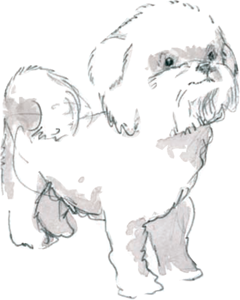
Start by having family members hand-feed while they stare at and touch the pup. Touch her very gently at first. Gradually, increase the force of your handling. At the same time, you might want to increase the value of the rewards. Work up to being able to be only as rough as a typical child might be if left unsupervised. Not that any young child should be left unsupervised with a dog, but if it happens by accident, you want a dog who is as prepared as possible. After practicing for a week or so, invite a friend over and have her hand-feed your dog while she gently touch- es the dog and you handle the dog a little more roughly. Eventually, you should have a dog who is comfortable with just about anyone handling her in just about any way (within reason, of course).
Don’t Keep Your Puppy a Secret!
Remember, your puppy needs to meet fifty people before she is 4 months old. Make a point to invite your neighbors and their children over to meet your puppy. Neighborhood children are less likely to taunt or be afraid of a dog they get to know as a puppy. And when your dog is old enough to go outside, walk her on a different route at least once a day so she meets lots of unfamiliar people.
Socialization Checklist: Getting to Know People
✓ Family
✓ Friends
✓ Visitors (strangers)
✓ Children
✓ Elderly people
✓ Joggers
✓ Mail carriers and delivery people
✓ People carrying things (baseball bats, bags, umbrellas) ✓ People in costumes
✓ People in the park
✓ People in the street
✓ People in uniform
✓ People in wheelchairs
✓ People of different ethnicities
✓ People on bicycles, skateboards, and inline skates
✓ People wearing hats
✓ People wearing sunglasses
✓ People who move quickly
✓ People who move slowly
✓ People with facial hair
✓ People using canes and walkers
Getting to Know Animals
Some socialization to animals will have to wait until the pup is old enough to go to a puppy-training class. Because the pup may have been in virtual social isolation (at least to dogs) since coming into your home, socializing your puppy to other appropriate dogs now becomes a major priority. Once you have enrolled her in puppy class, your pup will have lots of opportunities to meet other pups. Remember, although it’s important, it’s not sufficient that your dog becomes friendly with just a small circle of canine friends. She must learn how to greet unfamiliar dogs as well.
Playing with another dog can be great exercise for your dog, both mentally and physically. Set up doggy play dates with friends and people from dog-training class. You can also use this time to practice having your dog greet people nicely by sitting.
When socializing with other dogs, it’s important to choose playmates carefully and monitor their interactions closely. Initially, let your dog play with pups of a similar age; then you can plan interactions with adult dogs who have good social skills and temperaments. While some dog parks can be a great experience for some dogs, they are generally not recommended as a starting point for socialization, as they can be overwhelming due to the constant influx of new dogs.
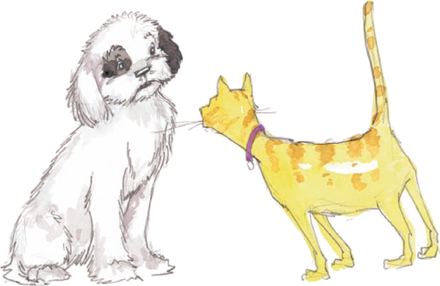
Cats and dogs can become the best of friends. But it helps to introduce them when the dog is a youngster. If you want to socialize your puppy to the resident cat, you have already done the right thing by starting early. It is generally much easier and safer for an adult cat and a young puppy to work things out than an adult dog and a young kitten. Have your pup on leash and give her a food-stuffed toy so that she is prevented from developing a habit of chasing the cat and instead learns to hang out calmly and play with her toys while the cat is in the room.
Depending on where you live, you may or may not want to socialize your dog to horses and livestock and to teach her not to chase or otherwise harass livestock or wild animals. Simply keep her on leash to prevent problems, and teach her to pay attention to you when you ask her to sit, lie down, and come when called (even around other animals). This training is covered in Chapter 7.
Socialization Checklist: Getting to Know Animals
✓ Dogs of all ages
✓ Cats
✓ Birds
✓ Pocket pets (hamsters, rabbits, rats)
✓ Horses
✓ Livestock
Getting to Know Places
You don’t want an adult dog whose fun and freedom are limited because she feels uncomfortable in strange places. So make it a point to take your young puppy or new adult dog anywhere and everywhere with you. Without a doubt, the single most effective and enjoyable socialization procedure is walking (or carrying) your pup on different routes on a regular basis. There is simply no other activity that will prepare your pup for her life ahead in the same way.
Puppy Class
Again, one of the most important places to take your pup is to puppy class. This is perhaps one of the most exciting things you can do with your young pup. You both will learn a lot and have the time of your life. For many owners, puppy school moments are some of the most cherished memories of spending time with their young dogs, as they are the foundation of learning how to communicate and bond with their canine companions. Don’t miss out on this wonderful opportunities. Anyway, you wouldn’t want to neglect your puppy’s education, would you?
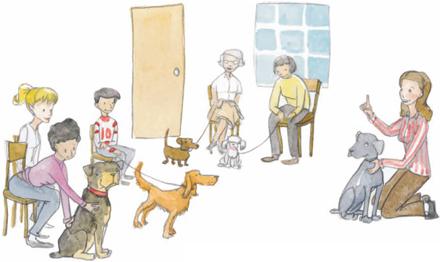
Puppy class is the best night out for you and your dog!
In puppy class, your pup will have ample opportunities to socialize with a variety of dogs and their owners. Apart from the fun aspect, the off-leash play sessions in puppy classes are essential for your puppy to learn bite inhibition and develop a soft mouth (see Chapter 5 for more on teaching your pup not to bite). Puppy class also provides a convenient opportunity for you to ask for professional advice on any pressing or potential puppy problems. To find a puppy class in your area, call the Association of Pet Dog Trainers at 800-PET-DOGS or go to www.apdt.com.
Socialization Checklist: Getting to Know Places
✓ Beaches
✓ Cars
✓ Crowded areas
✓ Dog-friendly shops
✓ Dog-training school
✓ Elevators and escalators
✓ Friends’ homes
✓ Frequent walks
✓ Gas stations
✓ Grooming salon
✓ Parks
✓ Pet stores
✓ Public transport
✓ Veterinarian
The Social Small Dog
One of the many benefits of having a very small dog is how easy it is to get her from place to place by carrying her rather than having her walk by your side. But be sure your small dog has adequate social experiences in a position other than in your arms. If you don’t, she may learn to be comfortable with things when in your arms but not when on the ground, since dogs are very specific learners.
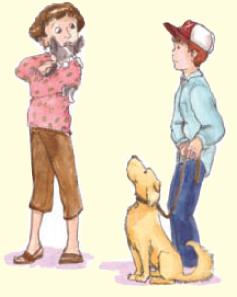
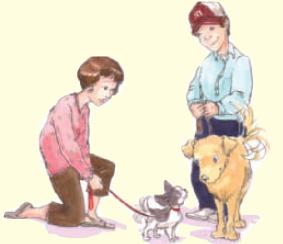
Being overly protective can cause Small Dog Syndrome. Help your small dog gain lifelong confidence by giving her a chance to encounter new experiences and challenges.