
The main focus of teaching impulse control is to stop everything when your dog gets into a demanding frenzy. Ignore your dog completely, and be sure she gets no access to the thing she wants. If she gets herself into a tizzy at the front door demanding that you open it for her, for example, simply stop and wait. Remain perfectly still. It shouldn’t take her long to figure out what she has to do to get you to open the door. When she remains still and quiet for a moment, mark with a click or by saying “yes” and reward her by opening the door. Likewise, as you prepare her meals, stop all preparations if she does anything other than wait calmly for you to finish. You can put the food out of your dog’s reach and walk away. Walk back to the feeding area when your dog is calm with four feet on the floor. This may take many repetitions, but eventually your dog will learn to stay calm while food is being prepared.
Silence Is Golden

If your dog is being impulsive, it is best to ignore her completely and make sure that she has no access to what she desires. This way, she learns that those behaviors don’t work. It may be difficult at first to teach this principle without saying words such as “off,” “down,” or “no,” but the benefit of this silent way of teaching is that your dog will learn to stay calm without you having to say these things constantly.
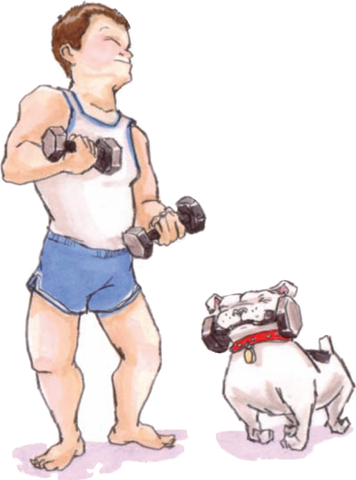
Repetitions are the key to building physical muscles and learning muscles.
To follow are some excellent impulse control exercises that you can begin to teach in a calm environment. As your dog masters these skills, practice them in more distracting areas and eventually implement them into your dog’s daily routine. For example, teaching your dog not to touch a treat on the ground until given permission to do so can be an exercise that you repeat at mealtimes when you place your dog’s food bowl or food-dispensing toy on the floor. Practicing these exercises in as many environments and as frequently as possible is the best way to develop a dog who understands that good things come to those who wait!
Since your dog is genetically predisposed to “take things now!” keep in mind that helping her learn to control her impulses in many different environments and scenarios will require many repetitions. For example, your dog might learn to show impulse control in the following exercises in your living room, but will need to essentially relearn how to control herself in more stimulating environments, such as on the street and around children and other dogs.
In addition to consistent repetition, be very generous with reinforcements so you convince your dog that waiting for something — which is typically not a natural instinct for dogs — is the best option.
Don’t Encourage Impulsive Behavior!

- Be careful not to accidentally decrease impulse control by:
- Giving your dog a meal after she jumps about as you prepare it.
- Allowing anyone to talk to your dog (even to say something like “off,” which is negative, but is still attention) when she jumps up.
- Allowing anyone to talk to your dog when she barks.
- Allowing anyone to let your dog out of her crate, exercise pen, or any other enclosure when she is jumping, barking, or whining.
- Allowing anyone to give your dog a treat when she jumps for it or takes it in a rough manner. (You should not feel teeth on your hand.)
- Allowing your dog to greet or play with other dogs when she drags you to- ward them.
- Allowing your dog to grab things off counters and tabletops.
- Allowing your dog to grab things from your hand.
For Most Dogs, Negative Attention Is Better Than None at All

Talking to or even looking at your dog when she barks, whines, or jumps is likely to reinforce the behaviors happening at that moment. For most dogs, any attention — even negative attention, such as yelling “no”— can be very reinforcing, as it is better than no attention at all.