
Sit
Most people can think of at least a few reasons for teaching a dog to sit. For example, you want your dog to sit instead of jump on people or to sit rather than run out the door. There are, however, many other uses for this position. In fact, a reliable sit is probably the most underrated and underused command in the dog world. Aside from socialization, “sit” is the best way to prevent and solve many behavior problems, including lunging when on leash, chewing inappropriate items, harassing the cat, barking, and overall lack of impulse control (see Chapter 6).
Good Times to Sit
- At the front door (going in and out)
- When greeting people
- While meals are being prepared
- In elevators
- Every 20 to 30 feet on a walk
- Before being let off leash
- Frequently during play sessions and games
- Before you throw a tennis ball or disc
- Before all good times (such as couch privileges)
Down
Generally, you use “down” to instruct your dog to remain in position for longer periods, such as in the living room while guests are getting settled and a lot of activity is happening. “Down” is also an aid for house training. By asking your dog to settle down for a lengthy period, you can accurately predict when he needs to go to his doggy toilet (when he gets up) and take him there to reward him when he goes. “Down” may also be used as an emergency command (for example, if your dog gets off leash, you can ask him to lie down to get him under control and back on leash) and to prevent a slew of unwanted and annoying behaviors.
Good Times to Down
Whenever a sit would be inappropriate (such as when you need the dog to be stationary for a long period)
- Every 20 to 30 feet on walks to ensure that he is attentive to you
- To calm an overexcited dog
- In the waiting room at the veterinarian’s office
- During your meals
Stand
“Stand” is the easiest position for examining and grooming your dog. If your dog stands still, your veterinarian and groomer will absolutely love you.
It’s also vital to teach a third position change. Stand is a wonderful choice. If you teach just sit and down and alternate between them (sit, down, sit, down, as in doing puppy push-ups), the dog learns to anticipate the next position. If he is sitting, the next position will be down. In this case, your dog doesn’t actually learn the meaning of the words, but rather that one behavior leads to the next predictable behavior. So each time you ask your dog to sit, he is likely to predict that down is next and go right into it. But if you teach at least three positions, your dog has to wait for the appropriate instruction. With three body positions to choose from, from each position there are two that you might ask for. For example, from a sit, you can ask your dog for a down or a stand, from a down you can ask for a sit or a stand, and from a stand you can ask for a sit or a down. So, by teaching three position changes, you are actually training the dog to pay attention and really learn what the words mean.
Good Times to Stand

- While being examined at the veterinarian’s office
- While being bathed and groomed
- When being petted by a person in a chair on a therapy visit to a hospital or nursing home
Preparation Checklist: Teaching the Basics
✓ Carefully choose the classroom.
✓ Precisely define the words you teach your dog.
✓ Teach your dog to pay attention when you say his name.
✓ Teach your dog a release word.
If you’ve accomplished all four of these steps, then you and your dog are ready to move on.
The Six Position Changes

Remember that when you are teaching three body positions, you’re actually teaching six position changes:
- Stand to sit
- Stand to down
- Sit to down
- Sit to stand
- Down to sit
- Down to stand
Some changes are easier or more difficult than others. For example, it’s easy to get a dog to stand or lie down when sitting; it’s much harder to get him to sit when lying down or to lie down from the standing position. Luck- ily, lure/reward training (see page 163) makes the process easier, and there is no better way to teach rapid position changes.
The Six Position Changes
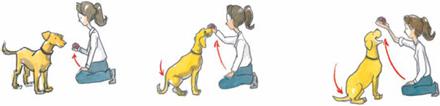
Stand to Sit

Sit to Down

Down to Stand

Stand to Down

Down to Sit

Sit to Stand
Name It When Your Dog Knows It!
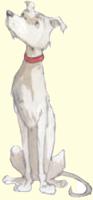
Reward-based trainers differ from traditional trainers in that they wait until the animal understands a behavior well before using a verbal command, or cue. A cue is the name you give a behavior, such as “sit.” Until your dog knows the behavior, it is useless to try to teach him a word for the behavior. You’ll just end up saying “sit, sit, sit!” with no response since your dog doesn’t know what you want.
When your dog confidently repeats a behavior in response to a hand lure or offers the behavior automatically, and you are sure that he understands what he has to do to get a reward, he is ready to learn the cue for the behavior. Teach your dog the cue by saying or doing it right before he repeats the behavior. For example, if your dog is sitting promptly and reliably after you take a step and stop, you know that the next time you do so he is likely to sit. So say “sit” right before you stop. As always, repetition and reinforcement are the keys to your dog understanding to listen for the cue that tells him to sit.