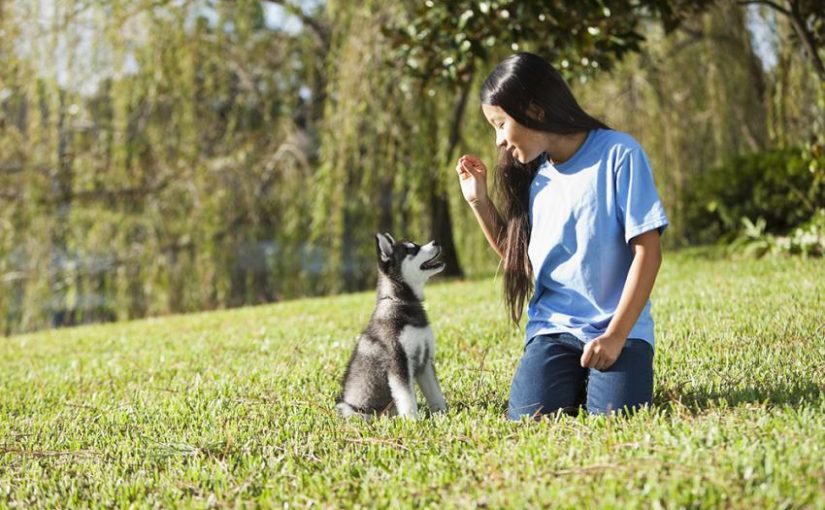
Good teachers prepare for class by creating a lesson plan and readying the classroom. This is the best way to optimize students’ learning potential. A little preparation on your part will facilitate your dog’s achievement of his full potential.
Choose the Classroom Carefully
Carefully choose the environment where you begin teaching your dog. Eventually, you’ll want your dog to respond to your requests under all sorts of conditions, but when you begin teaching something new, it’s best to train in an area with as few distractions as possible. This is usually in the quietest room in your home.
Precisely Define What You Want to Teach Your Dog
You should have a clear picture in your mind of what you are setting out to teach. Your lesson plan will be a precise definition of each word you intend to teach your dog. You don’t have to use the same terms I use here (I have included some alter- natives), but it is important to know precisely what you’re trying to teach before you try to teach it.

A trained dog gets to be an integral part of the family
For example, saying your dog’s name might mean “pay attention,” but how do you know for sure that he is paying attention? The best and most reliable way to assess this may be to see whether he looks at you. “Sit” might mean for your dog to immediately place his bottom on the ground exactly where he is and remain there until the next instruction is given, regardless of the situation and the level of distractions. “Down” might mean for your dog to immediately place his body on the ground exactly where he is and remain there until the next instruction is given, regardless of the situation and the level of distractions. “Walking nicely by your side” might mean that there should be no tension on the leash and the dog should re- main on one side of you. “Come” might mean to run to you immediately when called and to either sit or remain close enough for you to grab his collar.
Think about how to apply the basic commands in everyday life so that you and your dog get the full benefit of this shared language.

It helps to be 0animated if you want to capture your dog’s attention.
Get Your Dog’s Attention
Before you can teach your dog anything, you must be sure that you can get your dog’s attention. If you’ve followed the advice in Chapter 1 on controlling the re- sources in your dog’s life, you’ll find that your dog is already paying a whole lot of attention to you. Also, encourage your dog to make eye contact with you many times throughout the day, praising him for even momentary glances initially. Eventually, you should be able to get your dog’s attention even in distracting circumstances. But start to teach this in your home, without a lot of distractions.
What’s in a Name?
One of the most important words to define for your dog is his name. When you say your dog’s name, it should mean that you want him to pay attention and look at you since you are about to give further instructions.
Too many dogs think that their name means “bad dog.” Be sure not to use your dog’s name when you’re unhappy with him. Moreover, if you repeat your dog’s name over and over without consequence, he will eventually learn to tune you out. The best way to teach your dog to pay attention when you say his name is to hand-feed him his meals for a week. You don’t have to hand-feed each and every piece of food, but the more pieces you hand-feed individually, the more dramatic the difference you will see in your dog’s responsiveness to his name.
Say your dog’s name in a happy, bright tone. The instant he looks at you, click or say “yes” and give him a piece of his meal. Within a few repetitions, your dog will start to understand that when he hears his name, he should look at you to hear the marker (click or “yes”), which means that he will get a reward.
Once your dog readily responds to his name by glancing at you, it is time to work toward increasing the duration of the glance. Your goal is to have a dog who is able to maintain attention (eye contact) for a reasonable period of time. Your dog should eventually be able to maintain eye contact for at least fifteen seconds.
Although a quick glance in your direction in response to his name was sufficient attention for a reward initially, now require your dog to look at you for two seconds before clicking or saying “yes” to mark the behavior of looking at you and focusing his attention on you for two seconds and then rewarding him. Next time, you might wait for him to look at you for three seconds. In upcoming three- to five- minute training sessions, you can gradually increase to five seconds, eight seconds, ten seconds, and so on. Before you know it, your dog won’t take his eyes off you.
Now move to different rooms in the house. When you move into areas with more distractions, you’ll need to increase the rewards until he gives you attention there. Your goal is to teach your dog to look at you when he sees a distraction, as it is an opportunity for more reinforcement.
Eventually, when your dog reliably understands to look at you and focus until you ask him to do something else, repeat the process without food or other re- wards on your person. Instead, say his name, and when he looks at you, let him know what a great dog he is. Occasionally, go get a reward (food, a toy, or his leash to take him for a walk!).
Remedial Action

What if your dog doesn’t look at you when you say his name? Ignore him and play with a toy he likes a lot. If he tries to join in, continue to ignore him. Or produce something yummy and eat it yourself. Then try again!
Training Game for Attention
Ask a friend or family member to be your assistant in this game. Give her some food to hold while you have something your dog loves in your pocket. Sit a few feet apart. Have your assistant show your dog the food distraction, but she must not give it to the dog. When the dog is distracted by the food, say your dog’s name. If your dog looks at you, mark the behavior with a click or “yes” and offer the high- level reward you were hiding, plus the food distraction from your assistant as an additional reward (you can use very tiny pieces).
If your dog does not look at you, walk over to him and show him what you had to offer him. Let him know how bad you feel for him that he missed out on getting it. Sit down and completely ignore your dog for a minute. Then have your assistant distract him again, and you say his name again. Chances are that you will get his full attention this time. By having your assistant never actually give your dog any food, she is helping you to show him that paying attention to this distraction is no good. You are the only slot machine that is rewarding in this casino!
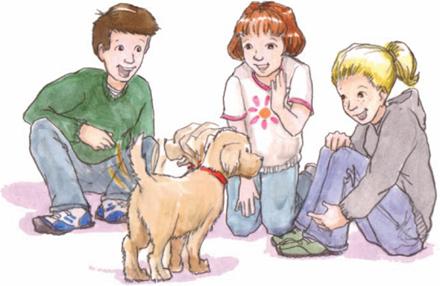
Teach your dog that coming when called is a fun game by calling him back and forth between family members who praise and reward him for each correct response.
Choose a Release Word
Unless you expect your dog to look at you or stay in a position forever, you’ll need to choose a word that means he is released and is essentially on his own time. A lot of people use “okay” or “all done.” From here on, you will be teaching your dog that the only time he is released is when you have given another command, given his release word, or marked a behavior with the clicker or the word “yes,” which means that he has accomplished the behavior you wanted and is done. The clearer you are in this regard, the easier you will make things for your dog. It will confuse him if you sometimes allow him to get up from a sit before you have said the re- lease word and then other times get frustrated and reprimand him for doing so.
A great way to teach your dog that training is fun is to ignore him when you re- lease him. You want your dog to beg you to ask him to do something else so that he has another opportunity to interact with you and be rewarded. You want a dog who loves to be in the training game, not a dog who anticipates being released.
So, when you begin teaching any of the basic positions (sit, down, and stand), be sure to say “okay,” “all done,” or whichever release words you choose to let your dog know that he may move. At first, this will be after a one-second position hold, but you will gradually build up to three, five, ten seconds and more before you release.
Teach your dog his release cue simply by saying it and then calmly encouraging him to move. If you are using a clicker and/or the word “yes,” note that this marker lets your dog know that he is all done as well. You can offer the food reward from your hand or drop it on the ground to encourage your dog to move out of the position he was in.