Вавада безопасные ставки на спорт выгодные предложения
Вавада безопасные ставки на спорт выгодные предложения
Выбор надёжной платформы для размещения пари важен для успешной игры. Исследуйте источники, которые предлагают доступ к анализу спортивных событий и стратегиями ставок. Предпочтение стоит отдать тем, кто демонстрирует высокую репутацию и прозрачные условия.
Обратите внимание на бонусы, которые могут значительно увеличить ваш банкролл. Наличие привлекательных акций и программ лояльности может сделать процесс игры более увлекательным и прибыльным. Читайте отзывы пользователей о различных сайтах, чтобы убедиться в их надёжности и качестве сервиса.
Рекомендуем ознакомиться с официальным сайтом vavada для получения самой актуальной информации о доступных возможностях. Важным аспектом является безопасность транзакций и конфиденциальность персональных данных, что позволяет сосредоточиться на ставках без лишних беспокойств.
Как выбрать безопасные ставки на спорт на платформе Вавада?
Обратите внимание на отзывы пользователей. Изучите форумы, социальные сети и специализированные сайты. Реальные оценки помогут понять, насколько платформа надежна и как она реагирует на различные предложения. Будьте особенно внимательны к упоминаниям о задержках выплат и проблемах с обслуживанием клиентов.
Проверьте доступность службы поддержки – опытные операторы должны быть готовы ответить на ваши вопросы 24/7.
Изучите условия бонусов и акций. Иногда привлекательные предложения могут вести к скрытым условиям, которые затрудняют получение выигрышей.
Оцените интерфейс и удобство платформы. На интуитивно понятных и легко навигируемых сайтах делать выбор значительно проще. Плохая структура может привести к ошибкам и недоразумениям.
Рекомендуйте начинать с небольших сумм, чтобы лучше понять функционал и безопасность платформы.
Проверьте наличие программ по борьбе с азартной зависимостью, что свидетельствует о серьезном подходе к вопросу ответственности.
Обзор выгодных предложений и акций для новых пользователей Вавада
Для всех, кто только начинает свой путь в азартных развлечениях, отличным стартом станет привлечение бонусов и бонусных средств. Регистрация в качестве нового клиента открывает доступ к различным программам поощрения, в числе которых приветственные бонусы и акции с кэшбэком. Некоторые предложения могут достигать 100% от суммы первого депозита, что значительно увеличивает стартовый банк.
Приветственные бонусы
Чаще всего новые игроки могут рассчитывать на приветственный пакет, включающий в себя как денежные средства, так и бесплатные вращения. Обычно первый депозит удваивается, что позволит использовать больше средств для игры. Не забудьте ознакомиться с условиями отыгрыша, так как они могут отличаться для различных акций.
Также выгодно обратить внимание на бездепозитные бонусы. Это значит, что вам не нужно осуществлять вклад, чтобы получить определенную сумму для игры. Такие предложения, как правило, доступны в рамках промо-кампаний и позволяют попробовать игровые автоматы без риска для собственного бюджета.
Кэшбэк и акции на повторные депозиты
Ещё одним интересным вариантом являются кэшбэк-акции, где часть проигранных средств возвращается на счёт. Это создаёт дополнительную степень безопасности при игре – и позволяет, даже в случае неудачи, уменьшить ущерб. Главное – следить за условиями и периодами действия таких предложений.
Не пропустите возможность воспользоваться акциями на повторные вложения. Некоторые платформы предлагают эксклюзивные бонусы для постоянных клиентов, предоставляя дополнительную сумму или вращения в случае внесения очередного депозита. Эти предложения могут быть намного щедрее, чем обычные, так что стоит делать вклад с умом.
Рекомендуется подписаться на новости и рассылки от сервиса, так как это позволит первым узнавать о грядущих акциях и специальных предложениях. Периодически бывают сезонные акции и турниры, которые позволяют увеличить выигрышный потенциал на крупных мерах.
Используйте промокоды, которые часто встречаются в интернете и предоставляют дополнительные преимущества. Они могут дать возможность не только повысить стартовый баланс, но и открыть доступ к эксклюзивным играм или турнирам.
Выбирайте предложения, которые соответствуют вашим интересам и стилю игры. Сравнивайте различные варианты, изучайте отзывы других пользователей и тщательно продумывайте свои действия, чтобы получить максимальную выгоду от азартных развлечений.
Проверка статистики и аналитики перед ставками на спорт в Вавада
Перед принятием решения о позиции стоит провести анализ последних встреч команд или спортсменов. Это включает изучение не только результата, но и общей игры, ошибок и сильных сторон каждого участника. Например, если один из клубов имеет положительную динамику в домашних матчах, выделите это в своих расчетах. Анализируйте, какие факторы влияют на их успех, такие как состав команды или наличие травм.
Статистические данные также играют важную роль. Изучите статистику за последние сезоны: количество забитых и пропущенных мячей, процент успешных передач, количество фолов и карточек. Это поможет составить более полное представление о текущей форме команд и их готовности к предстоящей встрече. Сравните эти цифры с аналогичными показателями противника для более глубокого понимания ситуации.
Не забывайте использовать инструменты аналитики. Множество платформ предлагают визуализацию данных, графики и таблицы. Это позволяет не только получать информацию, но и быстро ее интерпретировать. Обратите внимание на индексы команд в карьере отдельных игроков, а также на влияние внешних факторов, таких как погода или место проведения матчей.
Одним из важных аспектов является изучение мнений экспертов. Чтение аналитических статей и прогнозов может дать дополнительные идеи и подходы к оценке матчей. Комбинируя аналитику с мнениями профессионалов, получаете более полное представление о ситуации и обоснованные решения для следующего шага.
Как выбрать лучшие бонусы в казино для успешной игры
Казино бонусы
При выборе привлекательных предложений стоит обратить внимание на условия их использования. Необходимо заранее проанализировать требования по ставкам и сроки действия. Чем ниже значение отыгрыша, тем выгоднее предложение. Возможно, обнаружите бонус без депозита, который не подразумевает финансовых вложений, что значительно облегчает старт.
Также следует оценивать разнообразие доступных акций: регулярные бонусы на пополнение счета, кэшбэки и безрисковые спины могут разнообразить игровой процесс и увеличить шансы на победу. Кроме того, обратите внимание на репутацию заведения. Проверенные и авторитетные площадки чаще предлагают более честные условия.
Не менее важным аспектом является анализ отзывов пользователей. Нередко опыт других игроков может помочь выявить подводные камни, о которых не указано в условиях акции. Уделив время такому исследованию, можно существенно повысить эффективность своих действий.
Анализ условий wagering для различных типов бонусов
Оптимальные условия отыгрыша, или wagering, значительно различаются в зависимости от вида поощрения. Например, фриспины часто имеют более рыхлые требования к отыгрышу по сравнению с депозитными поощрениями. При выборе акций с фриспинами важно обращать внимание на множитель, который может варьироваться от 20x до 50x. Сравните условия отыгрыша в нескольких залах, чтобы обнаружить наиболее выгодные предложения.
Кэшбэк-бонусы имеют самые простые условия отыгрыша, что делает их привлекательными. Чаще всего необходимо отыграть лишь небольшую часть, например, 10x от суммы возврата. Однако важно учитывать период, в течение которого кэшбэк активен. При анализе таких предложений следует внимательно следить за временем, чтобы не упустить возможность воспользоваться ими. Осознанный подход к различным требованиям позволит повысить шансы на прибыль.
Сравнение депозитных и бездепозитных предложений на практике
При анализе депозитных и бездепозитных акций следует учесть, что оба варианта имеют свои плюсы и минусы. Депозитные предложения выдают бонусы на основе суммы внесенных средств, тогда как бездепозитные доступны без стартового взноса. Это две разных стратегии, которые могут кардинально менять подход к азартному времяпрепровождению.
Депозитные предложения обычно предлагают более значительные суммы. Например, при внесении 100 долларов может быть начислено 200% от суммы, что дает 300 долларов. Таким образом, это привлекает игроков, готовых рисковать. Зная это, важно тщательно рассчитать, насколько комфортно будет играть на эти средства.
С другой стороны, бездепозитные акции чаще всего предлагают меньшие суммы, например, 10-50 долларов. Уникальность таких бонусов заключается в том, что начать игру можно без первоначальных вложений. Это отличный вариант для новичков, позволяющий протестировать платформу и ознакомиться с играми.
Депозитные предложения:
Большие бонусы.
Требования по отыгрышу могут быть жестче.
Возможность более длительного игрового процесса.
Бездепозитные акции:
Удобны для экспериментов.
Минимальные риски.
Часто имеют высокие требования к отыгрышу.
Важно просмотреть требования по отыгрышу для каждого предложения. Часто депозитные акции имеют более выгодные условия, однако могут требовать большего времени для выполнения. Бездепозитные предложении чаще всего связаны с обязательством отыграть выигранные средства в короткие сроки, что может привести к риску потери средств.
При выборе между этими вариантами полезно учитывать личные финансовые возможности и уровень комфорта с рисками. Игроки, которые привыкли к азартным приключениям, могут предпочесть депозитные промо-акции, чтобы получить максимальную выгоду от своих вложений. Новички или скептики могут начать с бездепозитных предложений для минимизации рисков.
Примечательно, что некоторые платформы предлагают комбинацию обоих типов акций. Например, возможность получить начальный бездепозитный бонус, а затем воспользоваться депозитной акцией после первого успешного опыта. Это дает возможность оценить платформу и ее игры перед более серьезными действиями.
Тщательный анализ условий и предложений поможет сформировать оптимальную стратегию. Участие в депозитных акциях может привести к большим выигрышам, тогда как бездепозитные варианты служат хорошим стартом для знакомства с азартными развлечениями без риска потерять собственные средства.
Проверка репутации казино и отзывов игроков о бонусах
Изучите информацию о лицензировании и регулирующих органах. Наличие лицензии от уважаемых организаций, таких как Мальта или Гибралтар, подскажет о законности операций и защите прав игроков. Рекомендуется обратить внимание на срок существования заведения, так как долгое наличие в сфере увеличивает шансы на то, что оно серьезно относится к своей репутации.
Сравните различные ресурсы, чтобы получить шире представление о мнениях игроков. Независимые обзоры часто содержат полезные детали о конкретных предложениях, включая акционные условия. Используйте агрегаторы, чтобы видеть итоговые оценки и направляющие комментарии. Базируйте свои решения на объективной информации, полученной из нескольких источников.
Обратите внимание на предложение, которое поможет вам быстро найти доступные пути для игрового опыта в этом увлекательном месте. Если вы ищете способ обойти ограничения и продолжить наслаждаться игрой, рекомендуется использовать альтернативный доступ, предоставленный непосредственно на официальном сайте. Например, вы можете перейти по ссылке на Pinco, чтобы быть в курсе всех актуальных обновлений и новинок.
Важно оценить, какие источники наиболее надежные. Исключайте непроверенные платформы и обращайте внимание на официальный сайт, который гарантирует высокое качество сервиса. На сегодняшний день профессионалы отмечают, что умение находить правильные ссылки обогащает опыт игроков и позволяет наслаждаться процессом без лишних проблем.
Регулярно проверяйте обновления, так как информация может меняться. Это позволит вам всегда оставаться на шаг впереди и исключить любые трудности с доступом. Помните, что важно использовать проверенные источники, чтобы ваши игровые сессии проходили гладко и без неожиданностей.
Как найти рабочее зеркало Пинко казино на сегодняшний день
Чтобы быстро отыскать рабочую альтернативу сайта, пользуйтесь обновляемыми источниками в соцсетях. Многие игроки делятся актуальными ссылками на своих страницах, что делает поиск значительно проще.
Также можно обратиться на специализированные форумы, где участники обсуждают возможности доступа к игре. Изучите последние обсуждения, чтобы узнать, какие варианты оказались успешными для других клиентов.
Не забывайте о том, что служба поддержки объекта онлайн-развлечений может помочь вам. Заранее уточните, есть ли у них прямые ресурсы для доступа, если основной сайт недоступен.
Используйте поисковые системы, чтобы найти актуальные блоги или сайты, предоставляющие информацию о рабочем доступе. Существуют даже специализированные таблицы с значениями ссылок, которые могут оказаться полезными.
Проверка актуальности ссылок на зеркало Пинко казино
Регулярно проверяйте доступные адреса для перехода, чтобы избежать проблем с доступом к азартным развлечениям. Используйте специализированные сайты и ресурсы, которые обновляются в реальном времени, предоставляя пользователям рабочие варианты.
Также полезно следить за новостями и рекомендациями на форумах геймеров. Часто лекции юзеров содержат свежую информацию о доступных путях, включая советы по обходу блокировок и смене IP адресов.
Не забывайте о важности проверки безопасности. Перед тем, как перейти по новой ссылке, убедитесь, что это надежный источник. Воспользуйтесь антивирусом и браузерными расширениями, которые помогают определить фишинговые сайты.
И, наконец, храните все актуальные адреса в закладках или сохраняйте в текстовом файле на своем устройстве. Это поможет вам быстро находить рабочие варианты без необходимости каждый раз искать информацию снова.
Безопасность использования зеркал Пинко казино и советы по пользованию
Начните с проверки лицензии платформы. Убедитесь, что ресурс, на который вы заходите, имеет действующую лицензию, выданную авторитетным регулятором. Это один из основных показателей надежности и безопасности.
Используйте только проверенные источники для доступа к альтернативным адресам. Избегайте переходов по подозрительным ссылкам с незнакомых сайтов или из ненадежных источников. Проверьте отзывы других пользователей, чтобы избежать мошеннических сайтов.
Активируйте двухфакторную аутентификацию, если она доступна. Это добавит дополнительный уровень защиты к вашему аккаунту.
Регулярно обновляйте пароли и используйте сложные комбинации из букв, цифр и специальных символов.
Обсуждайте безопасность со знакомыми игроками и делитесь опытом о проверенных платформах.
Следите за обновлениями на официальном сайте. Часто операторы публикуют важные объявления о новых адресах или изменениях в политике безопасности, что поможет вам оставаться в курсе актуальных событий.
Внимательно изучайте условия и требования. Это позволит избежать неожиданных ситуаций и даст понимание о правилах работы сайта. При возникновении вопросов, используйте службу поддержки – это поможет вам быстро решить любые проблемы.
When it comes to the best way to train your dog, the sheer wealth and breadth of conflicting advice is often bewildering. Bookstores and pet shops sell a vast array of literally hundreds of different dog books, and each one recommends different training methods—jerk the leash, don’t jerk the leash; use food, don’t use food; always do this, never do that.
Worse yet, for the longest time most people have associated dog training with choke collars and leash jerks, assuming the whole process to be a chore and a drag. Wrong, wrong, wrong! An incredible rediscovery has been made in the field of dog training: Training your dog is fun! Better yet, the more fun you and your dog have while training, the faster and more effective training becomes.
Luckily for today’s dogs, the popularity of reward-based training grew steadily through the 1980’s and 1990’s and caused a dog-friendly revolution.
There are two objectives in training your dog: a major objective and a minor one. The major objective of friendly, intelligent pet dog training is to teach dogs to do things we want them to do. The secondary and minor objective is to teach dogs not to do things we don’t want them to do.
Dog-friendly dog training zeroes in on the major objective: teaching your dog what you want and rewarding him for doing it. This is the easiest way to train your dog. After all, there aren’t many things we consider “right” for pet dogs to do, so you really don’t have many things to teach. On the other hand, the list of “wrong” things that pet dogs can do is endless, so trying to train by punishing your dog for each mistake would be a lengthy and unpleasant process for both of you. When you have taught your dog to reliably understand you and consistently spend his time focusing on good behaviors, he won’t have the time or the inclination to be- have inappropriately.
For any natural dog behavior you can come up with, there are lots of inappropriate choices and usually just a few correct ones. For example, imagine the one right spot for your dog to use as his toilet (either outside or inside on papers or pads), and imagine how nice and easy it is to take him to that spot when he needs to go (and reward him for doing so).
Teaching Right Is Easier Than Teaching Wrong
Rewarding good behavior is the central tenet of dog-friendly training. Choosing to focus on rewards rather than punishments is the most important decision you will make with respect to educating your dog. Not only is doing so more fun — for you and your dog! — but it is also much easier. After all, there is a rather short list of right behaviors, but an almost endless list of wrong ones.
“Right” Behaviors
Eliminating in appropriate spot (s)
Playing nicely with people
Playing nicely with other dogs
Playing with dog toys (especially food-stuffed chew toys)
Responding to your requests (to sit, lie down, come, etc.)
Resting calmly indoors
Sitting to greet people
Walking nicely on leash
“Wrong” Behaviors
Eliminating in the house (in hundreds of different spots)
Playing roughly with people
Chewing on your clothes
Chewing on your furniture
Chewing on your plants
Chewing on your shoes
Chewing on your toys (CD’s, books, the remote)
Chasing the cat
Digging in your garden
Eating your food off the table
Fighting with other dogs
Guarding objects
Jumping up on visitors
Not responding to your requests
Pulling on the leash
Raiding the garbage
Running away
Barking for long periods
Add your dog’s annoying behaviors here:
You’ll have a whole lot of cleaning up to do after you’ve allowed your dog to test out all the wrong places to go to the bathroom.
Teaching your dog the one right spot to go to the bathroom is much easier than punishing him for going in innumerable wrong places.
Now imagine the hundreds of wrong places for him to urinate and how long it would take and how unpleasant it would be to punish your dog for going in each of those spots. Likewise, picture your house after your dog has tried out all the wrong things to chew. Now imagine how much easier it would have been if you had just gotten him hooked on a chew toy or taught him the one appropriate place to eliminate.
Catch Your Dog Doing Something Right!
It may be human nature, but we tend not to notice or to ignore good behavior and instead focus most of our attention on behaviors we don’t like. Try to catch your dog doing something right at least five times a day and reward him for doing it. You’ll find that each day it will be easier and easier to do so, because your dog will be learning the best ways to get your attention. For example, if he walks up to you and sits in front of you, let him know how pleased you are that he chose such a polite and friendly way to say hello. The more frequently he offers the right behavior, the less time he’ll have to do the wrong things.
Why else is rewarding good behavior so important? For the simple fact that once you have successfully taught your dog how you would like him to behave, he will no longer misbehave. And when he doesn’t misbehave, you have no reason to be upset with him. Do yourself and your dog a favor and start teaching your dog what you want him to do the first day he comes home with you. If you already have a dog, start today!
The principle of teaching what is right makes special sense during puppy hood. Not even twenty years ago, it was impossible to enroll a dog in obedience classes until he was at least 6 months old. This would be comparable to keeping children out of school until their late teens! By 6 months of age, most of those uneducated dogs were seriously out of control and required physically rigorous and mentally demanding training methods.
Thankfully, times have changed. Puppy training is widely available, and trainers, veterinarians, shelter workers, and breeders encourage new dog owners to begin teaching their dogs on the day they take them home.
Managing Unwanted Behaviors
Dog-friendly trainers focus on getting rid of unwanted behaviors through preventative management and lack of reinforcement. For example, if you keep your dog on leash when greeting people at the front door (preventative management) and nobody reinforces jumping (lack of reinforcement), your dog won’t be able to practice the behavior, won’t find the behavior very re- warding, and will try to figure out what behavior is rewarding. He is likely to try sitting as a way to get attention, at which point you should reward him to make this the greeting behavior he chooses in the future.
If the unwanted behavior persists, try to figure out what is reinforcing it. Sometimes the behavior itself is reinforcing, as is the case with some dogs who seem to get a thrill out of barking. In this situation, focus on providing your dog with more exciting activities than barking. How about giving him every morsel of his meals from food-stuffed toys so that he is kept busy working to get his food out? Or how about using management tools such as on-leash supervision or confinement to a specific area to prevent access to the most stimulating areas of your home (doorways and windows) until he has learned that excessive barking is not appropriate?
Rewarding your dog for being right is undoubtedly easier, more effective, and more fun than punishing him for being wrong. Moreover, you can speed up the process by responsibly managing your dog’s life to maximize the likelihood that he will be right. This way, much of the training becomes effortless, error less learning, and harsh correction or punishment is simply unnecessary. Simple and smart.
You should be especially concerned with management until the training takes effect. For example, until you have taught your dog to have a chew-toy habit, you should not give him unsupervised access to your home.
There are two parts to management:
Controlling the resources
Controlling the environment
Controlling the Resources
Dog resources include anything your dog likes:
Food (normal meals as well as special treats)
Praise (verbal and physical)
Activity-based rewards (going for a walk, playing with other dogs, getting up on the couch, riding in the car)
Play (games with you or just chewing a toy)
Dogs are masters at training us to do all sorts of things for them. Try to remember that you decide when it’s dinnertime, playtime, and time to go for a walk. Better yet, use those times to reinforce desirable behaviors, such as sitting for his supper or to go for a walk.
Most owners give their dogs free access to just about everything that is valuable to the dog. In fact, dogs are often rewarded with resources when they do things the owner doesn’t like! For example, the dog jumps around like a madman as his food is being prepared, and then the owner puts the bowl down for the dog to eat. Or the dog pulls on the leash, and the owner continues the walk. It’s so much smarter to take control of these resources and use them to teach your dog to be- have appropriately. In these two situations, wait to put the food down until your dog keeps all four feet on the ground, and wait to continue your walk until your dog is at your side.
Convince your dog that you hold the key to his “resource treasure chest” so that he realizes how valuable you are and how important it is to do as you ask.
Learn It to Earn It!
Your dog will benefit in endless ways if you teach him that appropriate behaviors are necessary to earn all the things he wants in life, including food, toys, attention, play with other dogs, and trips to the park. This approach is the best way to become your dog’s guide through a long, happy life with you.
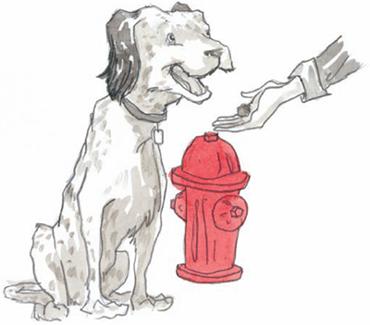
Controlled access to a limited commodity increases its value. It’s all a matter of supply and demand. If something is easily accessible and in great supply, the demand usually isn’t so great. Imagine if you had twenty million dollars. If someone asked you to do something for one dollar, chances are you would not be very motivated to do it. Consequently, make your dog’s resources more valuable by control- ling them. For example, pick up all your dog’s toys and ask him to come, sit, or lie down before you give him one or two to play with. Each time he comes to you for petting, ask him to do something before you comply. When you serve him his dinner, ask him to do something before you put his food-stuffed toy or bowl on the floor. Better yet, every once in a while, sit down and hand-feed him some of his meal and ask him to do something for each piece of food.
Similarly, when walking your dog on leash, regularly stop and wait for him to look at you and to sit before you continue walking. He will quickly learn that watching you and sitting when you stop is the way to ensure that the walk will continue. Let your dog know that you have what he wants, and if he wants it, he just needs to ask politely—in this case, by sitting at your side when you stop walking. Don’t feel bad about asking your dog to do a little something in return for re- sources. Dogs love to have a job to do. Most pet dogs have no job, and in turn they have a very boring existence. You, however, can change all that.
A Working Dog Is a Happy Dog
No matter what your dog’s size or type, he still needs a job to feel fulfilled and to achieve his full potential. Your dog’s jobs can include hunting for his food from food-stuffed toys, responding to your requests, and maybe even fetching your slippers!
Controlling the Environment
By preparing your house in such a way that your dog does not have access to areas By preparing your house in such a way that your dog does not have access to areas where he might make mistakes, you are essentially putting the odds in your dog’s favor that he will be right. Doing so from the outset with a new puppy or dog will prevent predictable behavior problems and the potential need for punishment. This is also the best way to prevent further problems with your current dog. Of course, once your dog reliably understands the house rules, he can enjoy as much freedom indoors as you permit.
Attention, Please
A result of controlling the things your dog wants is that you will get his attention. Attention is crucial if you intend to teach him. When your dog pays attention to you (and then follows your instructions), he has an opportunity to have you unlock the door to all the things he loves.
How can this dog not misbehave? The only options he has to occupy his time are ones that will annoy his owner. Creating a dog-friendly home, one in which he has little opportunity to make mistakes, is one of the kindest things you can do for your dog.
Controlling your dog’s access to areas where he might get into trouble is known in the dog-training trade as the “shut the door” notion. For example, if your dog is getting into the garbage in the kitchen, shut the kitchen door, confine your dog away from the kitchen, or get a garbage can with a lid that locks. If your dog is urinating in your bedroom, shut the bedroom door. Better yet, confine your dog to an exercise pen, a crate, or one room in the house. If you confine your dog, there are a thousand wrong things he can’t do in the other rooms. This is essentially the same way we teach young children to behave at home. You wouldn’t consider allowing a toddler to roam around unsupervised!
When you have time to supervise him, you can also keep your dog on leash at your side with a couple of food-stuffed toys. Doing so prevents so many problems that it would take a whole book to write them down. If you keep your dog on leash until he learns the house rules, he can’t chew inappropriate things, eliminate in the wrong places, and so on. This is, of course, a temporary but necessary aspect of training. Once the dog has learned good habits, a lifetime of freedom in the home awaits.
Set Your Dog Up to Be Right
Stack the deck in your dog’s favor so that he can’t fail to be right. If this is done properly, he should have no alternative but to behave in the way you would like. For example, leave your dog in a crate or a protected room with three food-stuffed chew toys, and you are pretty much assured that your dog will quickly learn to enjoy chewing chew toys rather than a host of inappropriate household articles. He can’t destroy your house or bark incessantly if he is engrossed in his chew toys.
When teaching your dog to respond on cue, he learns that the Antecedent (a cue, request, or command) followed by a specific Behavior (such as sit, down, or come) signals that a Consequence (reward) is likely to follow. These are the ABC’s of teaching:
Antecedent–Behavior–Consequence
A reward (Consequence) causes the behavior to increase in frequency. For example, simply giving your dog a piece of food every time he sits quickly produces a sit-happy dog who sits frequently. The reward also reinforces the association be- tween the request and the response, such that the dog learns that sitting when re- quested often produces rewards. Ultimately, the dog learns to want to sit on re- quest. If you want your dog to sit frequently without even being asked (such as at street corners or when greeting people), you can reward him when he places his rear on the floor without the cue. This is an automatic sit in specific situations. This way, he’ll learn that sitting, whether he’s asked to or not, is a good idea.
This training sequence represents an oversimplification of learning theory—the science of dog training. But your dog is going to learn very quickly if you present the ABC’s.
Some examples of the ABC’s of learning are:
Antecedent
Behavior
Consequence
The dog hears you pick up the leash.
The dog comes to you.
You put the leash on your dog and take him for a walk.
The dog hears the word “sit.”
The dog sits.
You give the dog a tasty treat and praise.
The dog hears the doorbell.
The dog goes to the door and sits.
You open the door.
The art of dog training, though, depends very much on the skill of predicting or causing the behavior you are trying to put on cue and increase in frequency. For example, when you ask the dog to sit, how can you predict that the dog will sit so that you can reward him for doing so?
How you go about this is the main determinant of the efficiency and effectiveness of training. Basically, three techniques are used to predict or cause specific behaviors:
1.Simply waiting for the behavior to happen on its own (capturing/shaping)
2. Luring the behavior to happen (lure/reward training)
3. Physically prompting the behavior
As a dog-friendly trainer, you will primarily use numbers 1 and 2, gentle capturing and shaping and lure/reward methods, to motivate your dog to do what you want. Everyone, including children, can easily master these two quick and fun ways to train.
Brain or Brawn?
Brain power is far superior to physical power when it comes to dog training (and just about everything else, as a matter of fact!). Instead of trying to master difficult, time-consuming, and largely ineffective physical methods to punish your dog for countless wrongs, why not teach your dog what you want him to do by using reward-based techniques? It is so much easier and quicker, and a darn sight more enjoyable for you and your dog.
Almost everybody, including children, can train with their brain, but few people can master the rigors of physical training methods, and even fewer people enjoy this approach.
Physical prompting methods, on the other hand, are not appropriate for all dogs and all people. A child certainly should not be expected to physically prompt a dog to get him to obey. Even adults may be at risk if they resort to pushing and pulling some dogs. Overall, physical prompting is not as safe, easy, or effective as the other two approaches, and it’s probably not as fun for you or your dog.
Why Not Use Punishment?
A consequence of a behavior can be pleasant or unpleasant. While pleasant consequences reliably increase the behavior they follow, the result of unpleasant consequences is not as predictable. Unpleasant consequences often create anxiety and confusion and sometimes increase the frequency of other unwanted behaviors. For example, punishing a dog for urinating in one spot in the house may cause the dog to be scared to eliminate in your presence, in which case he may hide from you and eliminate in multiple spots throughout the house.
The stress from punishment comes from pain, but also from the dog’s confusion. Because most punishment happens after the fact, it is unlikely that the dog understands why he is in trouble, and therefore he is likely to become confused and stressed and may possibly shut down. Dogs in this state are sometimes mistakenly labeled as stubborn. In fact, the dog is opting out of the training game because he simply doesn’t understand how to play the game. Imagine if you were being tutored in a new language, and each time you made a mistake your teacher rapped you on the hand or yelled at you. Chances are you would not show up for future lessons, and you obviously would not learn this new language.
Capturing
The capturing method of training is also referred to as reward training. Capturing is an extremely simple method to master, and it is the method most likely to result in a reliably trained dog who, as a wonderful side benefit, has mastered the ability to learn.
Learning to Learn
Using this method can maximize your dog’s potential by encouraging him to be an active, thoughtful participant in training. This approach creates a dog whose ability to learn is greatly improved; he becomes very much a “thinking dog” who is confident and enthusiastic about playing the training game.
Using gentle, motivation-based training you will be creating a dog who is a terrific prob- lem solver.
All you have to do is wait for the right behavior to occur spontaneously before marking the behavior (with the sound of a clicker or “yes”) and then reward the dog.
For something simple such as a sit, the behavior is likely to happen quickly and is therefore easy to capture. For more complicated behaviors, such as jumping through a hoop, you shape the behavior by marking and rewarding small steps in the right direction toward the ultimate goal. For example, you might start by marking and rewarding the dog for stepping toward the hoop, which is held low to the ground. Then you might reward him for touching it with his nose, then for stepping a paw through it, and then his whole body, gradually increasing the height the hoop is held off the ground.
What Is a Marker?
A marker tells your dog exactly which behavior earned a reward. The marker occurs at the same exact time as the desired behavior or event, which is why some people call it an event marker. The marker is immediately followed by a reward. A marker can be a word, such as “yes,” but is more effective when it is a distinct and unique sound, such as the click of a clicker — a small, handheld tool that you press with your thumb. Unlike your voice, the sound of the click never varies. Also, the sound of the click is much easier for your dog to recognize than one word (such as “yes”) in what is probably a stream of words you are saying to him. As such, it’s easy for your dog to learn that the click means only one thing: What I did at the exact moment I heard a click is getting me a reward. This clear, sharp sound can have a dramatic impact on the clarity of your communications with your dog.
It usually takes just a few repetitions of pairing the marker with the reinforcement for your dog to associate the two. Since your dog wants to increase the likelihood of the reinforcement, he will increase (repeat) the behavior that happened when he heard the click.
Unlike lure/reward training, where both you and your dog exert relatively similar effort, capturing requires your dog to be the more active participant, to try to figure out what is expected at a certain moment in order to be reinforced. Your job is to carefully observe your dog so that you can deliver well-timed and frequent reinforcements.
Generally, at first, reward training takes more time than lure/reward training.
When you start, you are waiting for the dog to behave appropriately, and it usually takes him at least a few guesses to get it right. ]
During reward training, your dog will make many mistakes and incorrect guess- es at what you want, but each unrewarded mistake is important because it enables your dog to eliminate yet another unprofitable option. The more mistakes, the more your dog learns what is not rewarding. Eventually, your dog will hit upon what you want, and will soon repeat the immediately rewarded behavior many times. Dogs love playing this game.
For example, to train your dog to sit, take hold of a few pieces of his food, stand still, and wait for him to sit. He may go through a whole repertoire of behaviors, like jumping up and barking. Ignore all this and wait for the sit—he will do it eventually. When he sits, click or say “yes,” offer him a piece of food, and then do it again. (You might have to take a step to get your dog to stand up.) You will find that your dog sits more and more quickly each time. Soon, your dog will develop the notion of sitting after you take a step in order to hear the click or the word “yes,” which means that he gets a reward. Now you can predict when he will sit and say the word right before he does so—in this case, right as you are about to stop after taking a step.
Reward training techniques are extremely effective, which is why they are used almost exclusively for training bomb-detection dogs, search-and-rescue dogs, and top-notch obedience and agility competition dogs. These techniques produce reliable, happy dogs.
This technique is terrific for teaching all-or-nothing behaviors like sit and down. More complicated behaviors like a retrieve or a fancy trick are shaped by rewarding the dog for successive approximations to the desired behavior — when it’s not exactly what you want, but the dog is headed in the right direction.
What If My Dog Doesn’t Obey?
Reward-trained dogs want to perform behaviors that they have learned result in rewards. If your dog truly understands what is expected and desires the reward, he will respond appropriately. If he doesn’t, don’t assume that he is being spiteful or disobedient. Instead, ask yourself, Does he really under- stand what I’m asking in this environment, and am I being sufficiently re-warding?
Reward training is wonderful for all types of dogs, whether they are reserved (it helps build confidence) or aggressive (it helps build a stellar relationship between dog and handler and creates a dog who has a more positive outlook). Reward training is the method of choice for active and excitable adolescent dogs. It calms dogs more quickly than any other method. You simply ignore the adolescent antics and wait for the dog to do something good. It’s the quickest way to train an adolescent dog to pay attention, walk on leash calmly, and sit automatically when you stop. Dogs quickly learn that goofy antics like jumping about and barking don’t make anything happen, but standing still, sitting, and lying down are like switches that turn you on and give them praise, treats, and play time.
Anybody can reward train from anywhere, even when relaxing in an armchair. Reward training is great for all types of trainers, especially children and the elderly. Reward training methods are calming. There is no need to be upbeat and exciting. Instead, you can relax and enjoy watching your dog figure things out. Moreover, since you give no commands at the beginning, no one has any idea what you are trying to do, so you can’t look silly if your dog doesn’t quickly do what you have in mind! Don’t worry, though; in no time at all, everyone will know exactly what you are doing as they look on in amazement.
Markers and Treats Forever?
Once your dog understands a behavior on cue, there is not necessarily a need to click or offer a treat. However, you should maintain learned cues and behaviors by using a variety of reinforcements, including going for a walk, playing with another dog, and playing fetch. However, when you teach a new behavior or an “old” one in a new environment or around new distractions, you should use your marker and treats.
Lure/Reward Training
Luring is a way of getting your dog to move by holding a treat on his nose so that he follows the treat and goes into various positions when you move your hand. Lure/reward training is a hands-off method to get your dog to do what you want him to do and then reward him for doing it. Food from the dog’s normal, daily diet is perhaps the best way to lure, but special treats, tennis balls, and stuffed chew toys also work well. You can entice your dog to move his nose, which gives you control over his entire body, just by moving a small lure. By manipulating the lure, you can:
Modify the dog’s body position (sit, down, stand, roll over, spin)
Modify the dog’s direction of movement (come here, go there)
Get him to focus on specific objects (chew toys, tennis balls, you)
Modify natural canine behaviors (chewing, digging, barking) Lure/reward training is an effective way to get your dog to enjoy training and the trainer. For example, ask your dog, “Do you like training with me as much as I do with you?” and then move a piece of food up and down in front of your dog’s nose. Magically, he will nod his head in agreement. Then offer the food lure as a re- ward for agreeing with you!
Using lure/reward training, anyone, regardless of age or physical strength, can position any size dog.
Lure/reward training has numerous beneficial side effects, but the best is that it teaches your dog to like all types of people, especially children, men, and strangers. Dogs quickly learn to enjoy the company of anyone who takes the time to ask them to come, sit, lie down, and roll over in this gentle and rewarding manner. Your dog will also learn to like hands moving around his head and body. Most important, lure/reward methods offer an easy, nonconfrontational means for children to com- mandeer respect from the dog and train him to be happily and willingly compliant. Obviously, children can’t and shouldn’t physically force a dog to do anything, but with lure/reward training, children can exert mental control.
All reward-training techniques have advantages; because of its efficiency and gentleness, lure/reward training is a good method of choice.
What If My Dog Doesn’t Like Food?
If your dog is disinterested in the food lure, teach him to thoroughly enjoy food by hand-feeding him for a few days. In the meantime, interact with your dog using what he does like, such as praise, affection, balls, toys, games, and activities. For example, use your hand to lure the dog to sit and invite him onto the couch as a reward. Or use a tennis ball to lure him to come, but pet and praise him as a reward. However, because lure/reward training with food is so effective, it would be a smart prospect to train your dog to show a greater interest in it. You can pique your dog’s interest in food by leaving his meals down for just five to ten minutes at each feeding so that he learns to eat promptly, and by reserving his meals for training times. This way, you are teaching your dog when he is most likely to be focused on how to achieve the task at hand so that he may earn his food.
Physical Prompting
For years, dog training was pretty much synonymous with leashes and collars. The very notion of dog training conjured up visions of a trainer snapping the dog’s collar with the leash to motivate him to heel, or tugging upward on the leash and firmly pushing down on the dog’s rump to place him in a sit. At first, physical prompting seems extremely efficient and effective because the dog appears to respond promptly. However, physical prompting is deceptively complicated, and it usually takes an experienced trainer to avoid negative side effects.
This method requires:
Physical strength to push, pull, and jerk
Absolute consistency so that your dog learns that punishments are always an option
An excellent understanding of dog behavior so that you lessen the chances of getting hurt by a dog who fights back
One of the biggest flaws in some dog-training methodologies is that many trainers underestimate their own expertise. What comes so easily to them after twenty-five years of experience falls apart in the hands of a novice owner working with a novice dog.
Additional flaws to this approach include the fact that the dog may be distracted by the touch, and it overrides the other intended cues, such as verbal cues. Of equal importance is the notion of opposition reflex. One of Newton’s laws of motion is “For every action, there is an equal and opposite reaction.” So, if you push or pull your dog one way, chances are he will attempt to maintain his balance by pushing or pulling the other way. For example, if you try to push him to the floor, his natural reaction will be to brace his legs.
Few of us will succeed by jerking our dogs around. And if you’re working with a fearful or aggressive dog, physical prompting can result in disaster. An example is jerking a dog by the leash when walking down the street. If you do this frequently enough when passing children or other dogs, the dog may learn to associate a harsh correction with them passing. This association could understandably lead to some negative feelings — or worse.
Physical prompting requires that you have the requisite strength and agility to physically position your dog.
Talk about easy. This is the time to relax and meditate. Make sure to take this book along so that you have something to read while you wait for your dog to offer a behavior you like. Once he does, mark the behavior with a click of your clicker or by saying “yes,” and then reward him with a tiny treat. After the first five to ten correct behaviors are marked and rewarded, your dog will start to under- stand what you want. Now things start to move at a quicker pace, and in no time at all the dog’s performance is improving in leaps and bounds before your very eyes.
EFFECTIVENESS
Capturing produces a highly reliable performance because your dog is required to work through problems on his own and therefore develops a clear understanding of the task. Over time, the reliability is enhanced, because capturing increases a dog’s attentiveness by teaching him to be a great problem- solver and to be addicted to playing the training game with you. This method is ideal for all family members to work with all types of dogs, especially rambunctious and unruly ones. In fact, the more rambunctious and inattentive the dog, the better the effect. A dog of this type greatly benefits from learning to focus in order to problem-solve.
Friendly training methods have been used for years to train dolphins, whales, and grizzly bears. After all, you can’t very well put a choke collar on a whale and jerk him around a tank to get him to do want you want. If we can train these animals with friendly methods, we can certainly train our pet dogs the same way!
EFFICIENCY
Capturing is like getting on a roller coaster. The start of the ride may move a bit slowly, but then it takes off at a lightning pace, and before you know it, you’re flying along.
ENJOYMENT
Everyone (dogs included) loves capturing. One of the most enjoyable things about this way of teaching is demonstrating it to others. Of all the techniques in dog training, this one has the highest feel-good factor, since you’ll feel an amazing connection with your dog. As your dog learns to pay attention to your body language and to read every nuance and intention of your movements, you’ll soon get the feeling that your dog is looking at you like you are his sun, moon, and stars!
Lure/Reward Training EASE
This method is easy to master, and almost everybody in the family can do it. All you have to do is keep your hand steady and move the lure slowly to entice the dog to assume different positions. You can even keep your other hand in your pocket or behind your back.
EFFECTIVENESS
This is one of the most effective training techniques because the sheer speed and enthusiasm of the dog’s responses make it possible to practice many responses in a single training session. It is easy to master and to progressively practice for better reliability. Just as you repeat physical exercises to build muscle, so will you need to build your dog’s learning muscles. Lure/reward training is an easy way to build reliability through rapid repetition.
EFFICIENCY
The use of the lure in training is almost magical. An untrained puppy or adult dog can be lured into a sit, down, or stand—in fact, into any body position — in no time at all. Lure/reward training is very fast. It is a good method for a large percentage of the things you want to teach your pet dog.
ENJOYMENT
Lure/reward-trained dogs have fun, and their enthusiasm is infectious. Training a dog who is having a good time is fun! Since this method is so easy, the entire family, including supervised children, can take part in the training game.
Physical Prompting EASE
Physical methods are difficult for many owners, especially children, to master. Many novice owners understandably become frustrated in their attempts to master apparently simple techniques, which actually require considerable precision and strength.
EFFECTIVENESS
Physical prompting techniques often give the appearance that the dog is better trained than he is. The dog may look good on leash, but this is often a result of being shut down. He may act as if he has never been trained when released. In fact, the more you physically prompt a dog during early training, the harder it will be to achieve off-leash reliability later on.
EFFICIENCY
Physical prompting is deceptive because initially it appears that the dog is learning quickly. And he may be. He may quickly learn to sit when you pull up on the collar or push down on the rump, for example. However, it is not until the dog is off leash in the park that you learn you have barely started training. If your ultimate goal is verbal and distance control, physical prompting methods will at least double your training time because you will find that your dog responds only when on leash, when you can push and pull him about.
ENJOYMENT
Physical prompting is generally not very enjoyable for the dog. Who likes being pushed and pulled? If your dog doesn’t enjoy training, it is much less likely that you will.
Until the last century, dog training was a pretty friendly affair. Dogs were predominantly trained by using reward methods. And of course, if we go even further back in time, food and gentleness were the ways we lured canines into the human family.
Unfortunately, the 1900’s brought with it an array of confusing punishment- based dog-training techniques, and “Correct me if I’m wrong” became the mantra for the unassuming pet dog. Jerking on choke chains, yelling commands, and other menacing tactics became the hallmarks of popular, unfriendly dog-training methods. These techniques were harsh and demanding for both dogs and owners. In- deed, most dog owners found that the physical demands of these techniques were all but impossible to master. To better understand the dog-friendly approach, you need to understand where these punitive methods came from.
We’re in the Army Now!
Perhaps pet dog trainers looked to military training methods for guidance. Obviously, military training techniques were intentionally harsh in an effort to weed out more sensitive dogs in the preliminary training, rather than having them break down in the field. Now, of course, most well-trained military dogs are trained by using fun and games and toys and treats. Fun and friendly dog training has even invaded the military!
And Now We’re in the Woods?
The second factor that led to unfriendly, punishment-based training was an at- tempt to adopt the way wolves communicate to the dog-human training repertoire. This approach is severely flawed.
We first lured dogs into our lives by using food and kindness.
First, you don’t look, smell, or growl like a dog, and you don’t wear a furry costume and crawl around on all fours. The point is, it is impossible for people to communicate accurately in dog (or wolf) language.
Moreover, dogs and wolves have an extremely complicated social structure that is composed of a number of flexible hierarchies. As a dog owner, attempting to replicate this environment by attributing alpha (“top dog”) status to yourself is a simplistic approach doomed to failure. Working from the inaccurate premise that wolves teach each other by using consistent and severe physical corrections, trainers devised an adversarial, combative training methodology. Rather than teaching our best friends, we were advised to physically dominate our dogs to bring them into line.
In actuality, very little physical force is required to maintain the social stability of a pack of wolves or dogs. Cooperation and passive gestures ensure that each member has access to resources (such as food) and ensures the pack’s survival. If you really want to act like a wolf, forget the growling and scruff-shaking. Simply get control of the resources in your dog’s life and show your dog what he should do to get them (such as sit, lie down, come when called, or eliminate outside). This approach is comparable to being a boss who is kind and gentle while making it clear that you are the one who signs the paychecks.
The Leash: A Good Tool Gone Bad
Yes, this simple, useful, and important training tool has had some unexpected and long-lasting negative side effects on training.
A mere fifty years ago, many dogs lived in areas where they could safely be off leash, but now the increased population density necessitates that dogs are walked on leash. Rather than developing the notion of staying close (an important aspect of any relationship), the dog was kept close by means of a leash. The leash also made it easy to jerk the dog around, and soon leash jerks became the universal correction, almost to the exclusion of people using their intelligence and creativity in training. Indeed, the easy implementation of punishment is a major reason leash training has gained such a bad reputation over the years. The final result? Dogs who became desensitized to leash jerks or didn’t respond well to being bullied wound up being labeled stupid, stubborn, dominant, or aggressive.
Puppies Save the Day!
As people became dependent on physical and punitive training methods, it became almost impossible to train puppies. After all, you don’t want to jerk, push, and pull a little puppy, do you? So people were advised to wait to train their puppies until they were 6 months old and could withstand the rigors of training. I certainly agree that puppies do not do well with punishment-based methods, but then neither do most adult dogs!
This approach, of course, is disastrous. Scientists have long realized how crucial a dog’s early weeks of life are and suggest that waiting to train until a dog is all but grown is just plain silly. Waiting until your pup is 6 months old to start teaching him how to behave is like waiting to start teaching your child the alphabet and numbers until she is in her teens.
Puppies prompted the turnaround to the friendly, positive direction of yesteryear. Gentle methods of training used to teach young puppies were so much fun and so effective that people began to use them with adult dogs.
Not training puppies made matters even worse, because by the time they hit adolescence, they were out of control. Owners were at their wits’ end, resorting to almost any means — especially punishment — to gain control. Ironically, when they began to train their adolescent dogs, they used the same harsh methods they had originally avoided by not training at all!
Thanks go to veterinarian, animal behaviorist, and author Ian Dunbar, who brought puppy training back into fashion. By convincing people that they could and should teach their puppies when they’re young and making training a fun endeavor, Dr. Dunbar revolutionized the life of dogs around the world. There is no doubt that dogs everywhere say a daily group thank-you to Dr. Dunbar. Certainly, before Dr. Dunbar’s influence, you would have been hard pressed to find a puppy class, and there were precious few tail wags in training.
The impact of Dr. Dunbar’s fun and friendly puppy classes was overwhelming. Fun and friendly training methods worked so well with puppies that people started to use them with adolescent and adult dogs. And they worked so well with adult dogs that people tried them out on fearful and aggressive dogs, too. And bingo! It turns out that friendly dog training is the method of choice for fearful and aggressive dogs. Naturally, fearsome and threatening methods are not the way to connect with fearful and threatened dogs.
As you can see by visiting a few puppy-training and dog-training classes in your area, fun and friendly dog training has all but taken over the dog world. Classes are filled with giggles and wagging tails; kids are involved; formal obedience competitions are getting a serious run for their money from events such as fly ball, agility, and freestyle; and, most important, more dogs are learning how to be fun and friendly family members.
When to Begin Training?
Now! Right away! Using dog-friendly methods, it is never too early to train a puppy or a newly adopted adult dog. If you are planning to get a dog, read on. Reading this book will help you choose the best education for you and your dog.